top of page
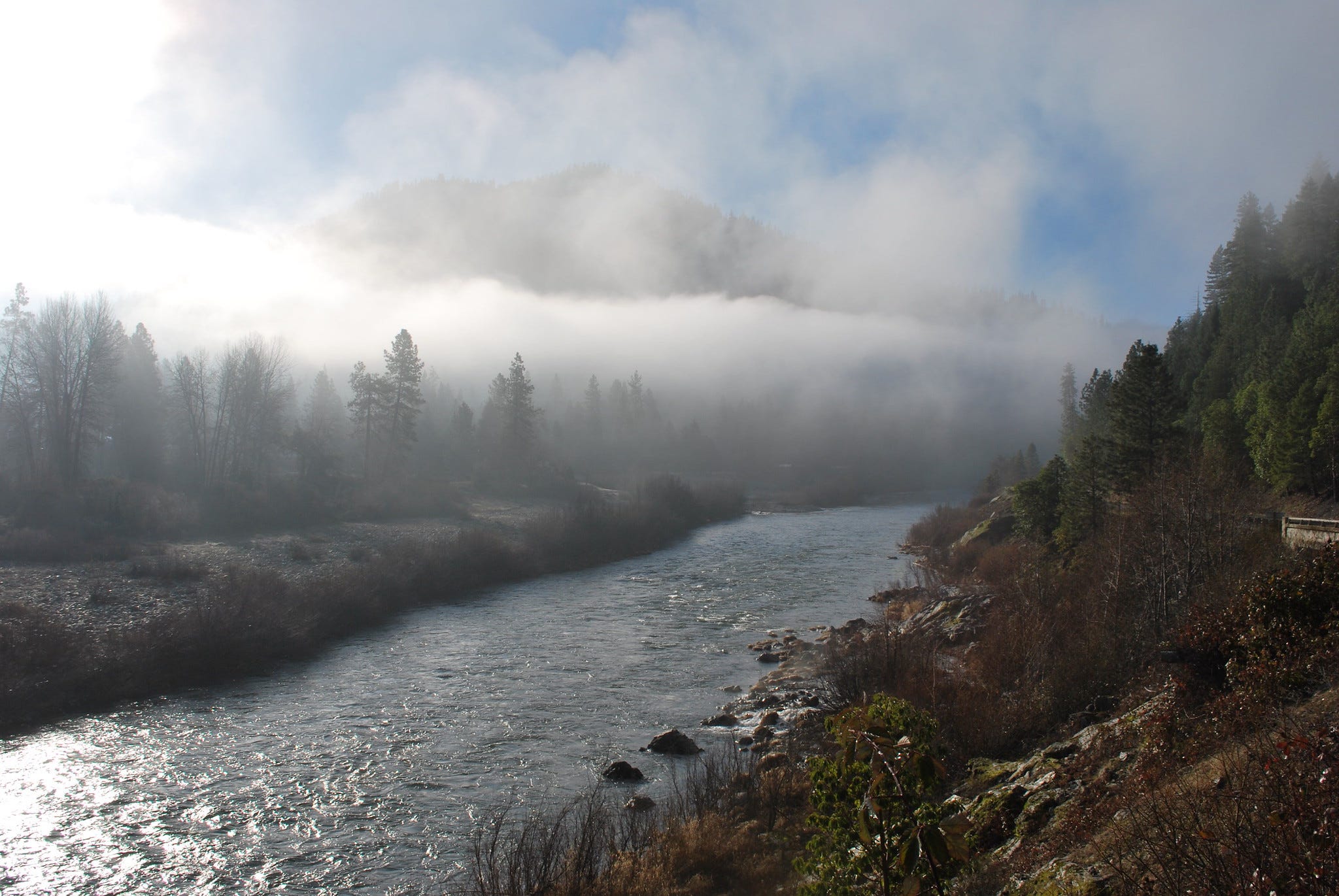
The Klamath River
Some of the same work that we white folks do to repair racial harm will also help heal ourselves and our Earth.
Ancestral Connections
Healing White History is a reader-supported publication. To receive new posts and support my work, consider becoming a free or paid subscriber.
I start with the roots of my own family history.
Last week you read about my tenth-great grandfather, Abraham Pieterson van Deusen, a prominent 17th century citizen of New Amsterdam, which we now call Manhattan. 1 Abraham and the other Dutch colonists displaced the Lenape and several other tribes from the island, establishing a colonial settler pattern that would build and spread across over the next few centuries – until we had wrested away almost all of our nation’s land from the First Americans.
Likewise, in Massachusetts around the same time, my Puritan ancestors “bought” land from the Norwottuck people for “220 fathoms of wampum, a large coat worth 8 fathoms of wampum…, and other gifts.” 2 My ancestors there “settled” the town of Hadley. A few years later, my ninth-great granduncle, the Congregationalist Rev. John Russell, Jr., almost certainly preached fervently to his flock that God commanded them to destroy the Wampanoag and other native peoples. 3
Almost two hundred years later in Texas, my third-great grandfather, Charles Arden Russell – the “slave trader in my family tree” 4 – would continue the family and white American settler tradition of seizing native land and displacing native people.
In March 1861, just as Texas had entered the Confederacy and the Civil War, Charley wrote his wife Emeline from Austin, where he was a member of Texas’ Secession Legislature. Having just voted for secession, Charley assured his wife that he and his legislative brethren would also make the Texas frontier safe from native “savages,” even after the Union army left the state. “It is to be deplored that a more thorough course has not heretofore been taken in regard to the Indians. Our law will raise 4,000 men – 2,000 Rangers, 1,000 artillery, and 1,000 infantry – and it will be the policy to carry on a war of Extermination against the Savages.” 5
At the time Charley wrote that letter, he was not only a member of the Texas Legislature, but also a leader in the paramilitary group, the Knights of the Golden Circle. In the words of Charley’s son Lyman, the KGC’s “chief aims were to annex Mexico to the United States, to continue the institution of slavery,” and to monopolize the cotton industry. Charley hoped that white folks would wipe Indigenous Americans off the face of the stolen land, and he and his brethren wanted to use that land to produce cotton with Black folks’ stolen labor.
These ancestral roots connect me to today’s Indigenous “Land Back” movement. But this connection is not about guilt and shame – it’s about justice, responsibility, healing, and preserving our shared Earth.
What Is the “Land Back” Movement?
Broadly speaking, the “Land Back” movement demands returning lands – and wealth generated by lands – to Indigenous people and communities. It is distinct from land-based reparations for Black folks – who for centuries had their labor stolen to work the land that had previously been stolen from Indigenous peoples. Racial repair for Black people requires access to land and housing as a matter of equity, and us white folks should embrace this as well. But for now, I’m focused on restoring “stolen land” to Indigenous people.
Across the United States, communities have begun to recognize the need for restoring stolen lands to Indigenous people. In 2024, the Yurok tribe received back 47,000 acres of their ancestral land along the Klamath River in northern California, from a joint effort by the Western Rivers Conservancy and California state agencies. 6 This conveyance “safeguards the long-term health of this critical ecosystem and culturally significant sites along the Klamath, which is home to one of the most important fall Chinook salmon runs on the West Coast.” 7
In Maine, the Trust for Public Land is partnering with Penobscot Nation to restore 30,000 acres of ancestral land to the tribe. 8 In Illinois in 2025, the Legislature transferred Shabbona Lake State Park to the Potawatomi Nation. This land restoration came 175 years after the Illinois State Land Office sold the land at public auction, breaking a treaty that had granted the land to the tribe in perpetuity. 9
Indigenous People and the Global Problem of Wildfires
Embracing the Land Back movement not only advances justice, but it helps preserve our planet.
As I write, wildfires burn across Canada and northern Minnesota, displacing thousands – most notably Indigenous communities – destroying millions of acres of forest, and creating smoke that has blanketed much of the northeast quadrant of the United States over recent weeks. In recent years, similar fires have destroyed communities in much of the western United States, Maui, and across the world. Climate change will continue to exacerbate fire risk globally over coming decades. We can manage this risk better if we return more land to the control of Indigenous communities, and borrow liberally from Indigenous practices in fire management.
For millenia, Indigenous peoples living in woodland areas have engaged in “cultural burning” practices, which have minimized the risks and impact of wildfires. Indigenous fire stewardship “involves small but frequent, low-intensity burns usually carried out during cooler, wetter periods. These burns reduce flammable fuel loads, encourage biodiversity and support livelihoods.” 10
And the benefits of Indigenous land stewardship practices extend much farther than fire management.
The traditional practices that Indigenous Peoples and local communities (IPLCs) apply in the stewardship of the environment, and the knowledge they have developed while living in and depending on natural resources, form crucial contributions to sustainability in the context of global environmental challenges including biodiversity loss. 11
This should come as no surprise.
Many indigenous traditions center the reciprocal relationship between the people and the land. As Laguna Pueblo author Paula Gunn Allen writes:
We are the land ... that is the fundamental idea embedded in Native American life – the Earth is the mind of the people as we are the mind of the earth. The land is not really the place (separate from ourselves) where we act out the drama of our isolated destinies. It is not a means of survival, a setting for our affairs ... It is rather a part of our being, dynamic, significant, real. It is our self ... 12
My ancestral colonial settlers embraced a different world view. For them, our planet’s resources were fuel to be extracted, consumed, and discarded in service of wealth and power. But all of us live and depend on this planet to survive. We all benefit from land stewardship that helps preserve our natural resources and extends the time that the Earth will sustain human life. Restoring Indigenous lands to the control of Indigenous people is not only about justice – it’s also about learning from those Indigenous folks how to partner, cherish, and connect with our Mother Earth.
How My Ancestral History Directs Me
We didn’t make the choices that our ancestors made. But we did inherit their stories, including the false, toxic stories of race and white superiority. And, of course, we also inherited the systems built from those false stories, which have ensured the continued racial hierarchy, preserving more wealth and power for us white folks.
This work is about taking responsibility to fix both the broken systems and the broken ideas that our ancestors’ poisonous stories passed down to us. This will not only correct injustice, but it will also help us. White people who engage in this work will be healing ourselves – in part by telling the truth about our history. But also by putting ourselves in right relationship with the Earth and with all the people, plants, and animals with whom we share it. And by helping preserve the Earth’s ecosystems so that they can continue to sustain all of us.
As a Negro spiritual and James Baldwin have warned us, “God gave Noah the rainbow sign, No more water, the fire next time!” 13 We don’t have to wait – the fires are here. But we can manage those wildfires and ourselves better by joining hands and learning from Indigenous communities and traditions. The answer is in how we form relationships with the land and with each other, acknowledging history, justice, and the need to preserve the Earth and our own health.
There’s no single path to follow. I’m not telling you to sign the deed of your house over to your local Indigenous nations. I’m not doing that.
But there are a lot of less severe actions we can take that will either directly provide stolen land back to Indigenous peoples, or will serve similarly-aligned healing purposes.
One possibility is to pay a voluntary land tax on the land you now occupy, to the people from which that land was stolen. In Seattle, thousands of folks are doing exactly that, through the group “Real Rent Duwamish.” 14 Another possibility is to provide payments to Indigenous-run land trusts that buy back land. Here in Texas, for example, the Texas Tribal Buffalo Project does exactly that for Lipan Apache people. 15 Third, you can support specific, named campaigns dedicated to a Land Back project. One current notable example is the effort by the NDN Collective and the nine Indigenous nations of South Dakota, demanding the return of the Black Hills of South Dakota to “the Great Sioux Nation.” 16
Finally, you might be able to push for a group or institution of which you are a part – for example, your church, employer, or municipality – to return stolen land it holds, or provide some type of compensation for that land.
For all of these efforts, you need to do the legwork to find out what Indigenous-led groups are calling for. This is not “white saviorism.” We should not be dictating how we can “help” Indigenous people. Instead, we need to listen to how we can provide resources for the self-determination that Indigenous people are creating for themselves.
For my part, I’m still exploring which of these opportunities to participate in Land Back are best for me. Stay tuned over coming weeks and months, and I’ll let you know.
The fires will still be burning. Will we continue to stoke them, or instead make it possible for Indigenous wisdom to damp them out?
Please subscribe to follow the arc: truth → healing → transformation & repair.
1 https://healingwhitehistory.substack.com/p/going-dutch-01d?r=e2z7c
2 https://collections.dartmouth.edu/occom/html/occom/ctx/placeography/place0093.ocp.html#:~:text=In%201658%20John%20Pynchon%2C%20on,gifts%E2%80%9D%20(Nash%2032) (accessed June 16, 2025) (citing Alice Nash, “Quanquan’s Mortgage of 1663,” in Cultivating a Past: Essays on the History of Hadley, Massachusetts (Marla R. Miller, ed. 2009). “Wampum” are polished shell beads of the Eastern Woodlands tribes of Native Americans. https://en.wikipedia.org/wiki/Wampum (accessed June 16, 2025).
3 https://healingwhitehistory.substack.com/p/they-believed-god-commanded-them?r=e2z7c
4
5 Alice Atkinson Neighbors, The Life and Public Works of Charles Arden Russell , at 44 (1936) (from the Dolph Briscoe Center for American History at the University of Texas at Austin) (quoting CAR letter of March 16, 1861).
6 https://www.yuroktribe.org/post/largest-ever-land-back-conservation-deal-in-california-now-complete (accessed July 20, 2026).
7 Id.
8 https://www.tpl.org/our-work/wahsehtekw (accessed July 20, 2026).
9 eter Hancock, “Potawatomi to reclaim tribal land in DeKalb County,” Capitol News Illinois (March 24, 2025) https://capitolnewsillinois.com/news/potawatomi-to-reclaim-tribal-land-in-dekalb-county/ (accessed July 20, 2026).
10 ames MacCarthy , Jessica Richter , Stephanie Borcea and Isabela Barriga , “How Indigenous Leadership Can Help Reduce Extreme Wildfire Risk,” World Resources Institute (Sept. 24, 2025). https://www.wri.org/insights/extreme-wildfires-indigenous-community-leadership (accessed July 20, 2026).
11 Louisa Parks and Elsa Tsioumani, “Transforming Biodiversity Governance? Indigenous Peoples’ Contributions to the Convention on Biological Diversity,” Biological Conservation (April 2023) https://www.sciencedirect.com/science/article/pii/S0006320723000332 (accessed July 20, 2026).
12 Annie L. Booth, “We Are the Land: Native American Views of Nature,” in Nature Across Cultures: Views of Nature and the Environment in Non-Western Cultures 329 (Helaine Selin, ed., 2003) (quoting Paula Gunn Allen).
13 This line is from the spiritual “Mary Don’t Weep,” which Baldwin borrowed for his book title, The Fire Next Time . https://paisano-online.com/24269/arts-life/james-baldwins-the-fire-next-time-is-a-guide-for-the-black-lives-matter-movement/ (accessed July 20, 2026).
14 https://www.realrentduwamish.org (accessed July 20, 2026). Notably, there has been significant controversy about this group and this effort. See https://www.seattlemet.com/news-and-city-life/2022/11/what-is-real-rent-duwamish-federal-recognition-muckleshoot-suquamish-puyallup-tulalip (accessed July 20, 2026). For me, this controversy demonstrates that white folks who want to participate in the Land Back movement first need to do some legwork to make sure that their efforts are going to the right place.
15 https://www.texastribalbuffaloproject.org/landback (accessed July 20, 2026).
16 https://ndncollective.org/all-nine-south-dakota-tribes-pass-resolutions-supporting-developing-legislation-to-return-federal-lands/ (accessed July 20, 2026).

bottom of page