top of page
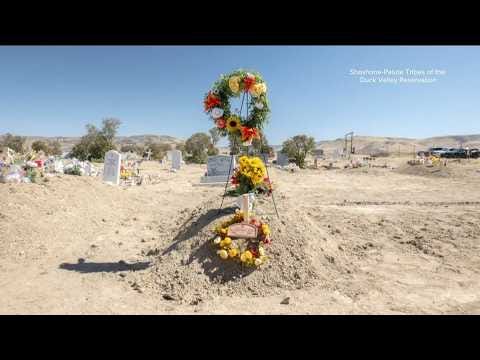
Three weeks ago – Sept. 17, 2026 – family members and the Shoshone tribe welcomed home Della Tuscarora Atkins to the Duck Valley Reservation in Owyhee, Nevada. She died as a 17-year-old at the Carlisle Indian School on Christmas Day in 1900, thirteen days after she arrived. Seven generations, 126 years, and 2,300 miles later, her people were finally able to celebrate her homecoming.
This story did not make national news. That fact itself lands hard with me. Unwinding the cultural and historical significance of Della’s death and homecoming is challenging. But I wish our national media thought she, her people, and her culture were worth the trouble.
Please subscribe to follow the arc: truth → healing → transformation & repair.
For the last few days I’ve been wrestling with the mysteries of what happened to Della, and why the Shoshone tribe claims that neither they nor the family were ever notified of her death more than a century ago.
Despite going down quite a few research rabbit holes, I haven’t solved most of those mysteries.
But I have learned a lot about why Della was sent to an Indian boarding school. And I figured out that my own ancestors helped create the mythology that landed her there.
Della is just one lost child among hundreds of thousands of other Native American children who lived at the more than 500 Indian boarding schools in the United States from 1819 to the 1960s. More than 3,100 of those children lost their lives, like Della.1 Virtually all of them lost their language, their culture, and key parts of their identities.
Here is Della’s story, as best I’ve been able to piece it together:
Della was born in 1883 or 1884. It’s not clear who her father was, or how she got the surnames Tuscarora and Atkins. By the time she was 16, she was a member of a family who lived in the Duck Valley Shoshone/Paiute Reservation in Nevada, along with her stepfather Charley McIntosh, her mother Pink McIntosh, and her (half?) brother Johnny.2
Sometime before June 1899, Della was sent to the Grand Junction Indian Training School in Colorado.
In early December 1900, recruiters from the Carlisle Indian Industrial School in Carlisle, Pennsylvania put seven or eight children from the Duck Valley Reservation on a train, where they began a rail trip of more than 2,300 miles, which probably took them about a week to complete. Della may have been with that group when they started in Nevada, or they may have picked her up in Colorado along the way. Either way, Della was with them when they all got to the Carlisle school, on December 13, 1900.
Less than a month later, on January 4, 1901, the Carlisle school newspaper, The Red Man and Helper , published this short note:
Two deaths have occurred since our last paper was issued [on December 21, 1900] – Della Aikens [sic] and Robert Scott. The former died with a tumor on the brain, she having been with but a very short time; in fact she was taken to the hospital the next day after her arrival from Nevada and it is thought that she had begun with the growth before starting on her journey, and the travelling no doubt aggravated the trouble. Robert Scott was a good, quiet boy. He was taken suddenly ill and died with valvular heart disease. While it is a fact that many hundreds of Indians are just now dying in their reservation homes, through various causes, and that our facilities enable us to save many a sick boy or girl who at home would be lost, yet the death of schoolmates casts a gloom over the school that is felt through and through.3
Today, Della’s family and tribe say they never received notification of her death because the school misspelled her name.4
Carlisle doctors might have diagnosed Della’s brain tumor from brain pathology after an autopsy, but there’s no evidence of that. More likely, they diagnosed her tumor based solely on clinical signs and symptoms, such as headaches, dizziness, etc. If the latter is true, then her fatal disease may not have been a tumor, but something else that causes similar symptoms, such as tubercular meningitis.
But, for me, the cause of Della’s death is just one relatively small piece of this puzzle.
Questions abound.
Did any parent consent to her being taken to boarding schools in either Colorado or Pennsylvania?
Why was she put on a week-long train ride if she was so ill?
Why didn’t the children’s escort on the trip (they had to have one), stop along the way to get her medical treatment?
After her death, did her family inquire about her?
Misspellings aside, did the school attempt to notify anyone?
On the consent issue, history teaches us that parental consent for their children being taken to an Indian boarding school was often absent or coerced.
These schools aimed to wipe out Native American culture, and indigenous people were well aware of this.
The Carlisle Indian Industrial School was the crown jewel in the federal government’s boarding school system. The school’s founder and head, Richard Henry Pratt, infamously declared the program’s purpose at a national conference in 1892: “Kill the Indian in him, and save the man.”5 “Discipline at the schools was severe and often swift. Beatings with belts, razor straps, rulers and fists by headmasters, matrons, nuns and priests were common.”6
Upon arrival, school officials immediately cut off braids of both boys and girls. They punished the children for speaking their native languages. They stopped them from wearing native clothing, and generally prohibited them from expressing their own culture in any way.
In 1893, Congress passed 25 U.S.C. § 283, which explicitly granted federal Indian agents authority to withhold rations, subsistence, clothing, and annuities from Indian parents or guardians if their children (ages 8 to 21) did not attend school during the preceding year. Thus, federal agents could threaten families with starvation if they failed to give up their children for boarding schools. That law stood on the books until 2022.
A related federal statute, 25 U.S.C. § 286, purported to soften the blow by requiring parental consent for a child to be taken to a boarding school outside their home state. However, because agents could still force the students to attend a boarding school in their home state, that gave them enormous leverage to force them to a school in distant lands. Parents would be told that the distant schools, like Carlisle, provided a better education. And, one way or another, their child would end up in some type of Indian boarding school.
Some Native families genuinely wanted their children to be taught to speak English and fit in with white society. Many did not.
After graduating from one of these schools, students would often return home unable to speak their Native language, without any cultural home. As Yankton Dakota Sioux daughter Zitkala-Sa wrote upon returning to her mother after four years at boarding school:
During a long night I cried aloud for a storm to come and use me... I was neither a wee girl nor a tall one; neither a wild Indian nor a tame one. This hedging me in on all sides made me crazy for my own freedom... Even my mother said inside her soul, ‘She will apply to something else, for she can no longer carry water from the river, or carry wood on her back.’ I was only a trouble to her.7
For me, one of the most chilling aspects of the American Indian Boarding School saga is that the proponents of the program believed they were helping First Americans. People like Richard Henry Pratt, the Carlisle headmaster, considered themselves reformers who were “Friends of the Indian.” But these were “white saviors” of the worst kind. Their notion of “helping” was to wipe out all vestiges of the “savage” indigenous cultures that were here when the colonists arrived from Europe.
And the story that Pratt and other reformers told – that indigenous culture must be replaced by the “superior” Western “civilization,” ties directly to narratives spread by my own Puritan ancestor, Rev. John Russell, Jr., in seventeenth-century Hadley, Massachusetts. Russell almost certainly preached to his congregants that Native Americans were the new “Canaanites,” and that his flock were God’s chosen people, under the divine command to wipe out the non-believers who occupied this new “promised land.” Disturbingly, this same Biblical story still animates poisonous elements of Christian nationalism today.8
I still don’t know exactly what happened to Della Tuscarora Atkins. But I can be pretty confident that my ancestors had at least something to do with it.
At least we know that seven generations later, her family finally had the chance to celebrate her – drumbeats, prayers, songs, and tribute.9
1 Dana Hedgpeth, Sari Horwitz, Joyce Sohyun Lee, Andrew Ba Tran, Nilo Tabrizy and Jahi Chikwendiu, “More than 3,100 students died at schools built to crush Native American cultures,” Washington Post (Dec. 22, 2024) https://www.washingtonpost.com/investigations/interactive/2024/native-american-deaths-burial-sites-boarding-schools/ (accessed Oct. 5, 2026).
2 Census of the Western Shoshone Tribe, taken by U.S. Indian Agent John Mayhugh, (1899) at 5–198 (author’s copy downloaded from ancestry.com on Oct. 5, 2026). However, it should be noted that family members in 2026 have said that Della moved from Duck Valley to Carlin at some point. Jimmy Romo-Buenrostro, “A Shoshone girl returns to Duck Valley 126 years after her death,” KNPR (Sept. 30, 2026) https://knpr.org/show/knprs-state-of-nevada/2026-09-30/a-shoshone-girl-returns-to-duck-valley-126-years-after-her-death (accessed October 5, 2026).
3 Red Man and Helper , vol 1, No. 25 (Jan. 4, 1901) at 2. https://carlisleindian.dickinson.edu/publications/red-man-and-helper-vol-1-no-25 (accessed Oct. 5, 2026).
4 “Shoshone girl repatriated to tribe after 126 years,” Native News Online (Sept. 24, 2026) https://nativenewsonline.net/sovereignty/shoshone-girl-repatriated-to-tribe-after-126-years/ (accessed Oct. 5, 2026).
5 Richard H. Pratt, “The Advantages of Mingling Indians with Whites,” in Proceedings of the National Conference of Charities and Correction, Nineteenth Annual Session Held in Denver, Col., June 23–29, 1892 , ed. Isabel C. Barrows (Boston: Press of Geo. H. Ellis, 1892), 45–59, at 46, https://carlisleindian.dickinson.edu/sites/default/files/docs-resources/CIS-Resources_1892-PrattSpeech.pdf (accessed Oct. 5, 2026).
6 Denise K. Lajimodiere, “Legacy of Trauma: The Impact of American Indian Boarding Schools Across Generations,” PBS show Native America (Oct. 20, 2023) https://www.pbs.org/native-america/blog/legacy-of-trauma-the-impact-of-american-indian-boarding-schools-across-generations (accessed Oct. 5, 2026).
7 Zitkala-Sa, American Indian Stories (1921) at 69.
8
9 “Shoshone-Paiute Tribes bring relative home after 126 years,” KTVB (Sept. 24, 2026)
(accessed Oct. 5, 2026).

bottom of page