top of page
Note: I’m traveling this week, so this is one from the archives. I hope you enjoy it the second time around.
I was 51 years old when I learned that race is just a story that white people created to protect their wealth and power.
Dallas 2019
I am sitting in the sanctuary of First Unitarian Church of Dallas on a weeknight evening, along with more than a hundred other folks, most of whom are white. We are here for a talk on the history of race by Rev. Dr. Thandeka, a Black Unitarian Universalist theologian and activist.
Thandeka begins her slide presentation in the Virginia colony in the 1600s, where two groups toil side-by-side under the lash of rich plantation owners. The first group are “bedraggled and penniless English laborers” who have been carried to the New World as “indentured servants.”1 The second group are Africans who have been stolen from their homelands and carried across the ocean in the filthy hulls of slave ships. Both groups, says Thandeka, “were called slaves.”2
Together, in 1676 many laborers from these two groups ran away from their plantations. Then,
Led by a wellborn Englishman named Nathaniel Bacon, the freedmen first slaughtered Indians and then turned their guns on the ruling elite. Bacon’s 1676 Rebellion did not end before Jamestown was burned to the ground and Bacon died. Last to surrender was a group of eighty Negroes and twenty English servants.3
Terrified by the prospect of further rebellious alliances between these two groups, the wealthy landowners of Virginia devised a solution. They would grant the European indentured servants a series of legal and social privileges that the Black-skinned Africans would not share. As one scholar describes:
The response of elites to the threat to their power that the rebellion had posed was to create ever firmer legal lines between poor farmers, indentured servants, and Africans, both enslaved and freed. Running away together was outlawed. Intermarriage was outlawed. Poor whites were granted more access to land, the right to participate in militias, and some legal protections, privileges denied to Africans. At the same time, the wealthy planters became determined to replace the system of indentured servitude with slavery itself.4
Certainly, anti-blackness had reared its head in various ways for centuries before Bacon’s Rebellion, and the Virginia colonists had begun creating legal racial categories in the decades leading up to it. The story of race doesn’t have a single, defining moment of emergence.5 But, on the whole, up until Bacon’s Rebellion, “class prejudice was difficult to distinguish from race prejudice because the indentured servants of all colors were treated as members of the same race: the poor.”6 “The law separated the members of the lowest class by color and lifted one higher than the other. The goal, as it has been ever since, was to offer just enough racial privileges for white workers to identify with their color instead of their class.”7 And this is how the story of race was born.
Listening to Thandeka in 2019, I was quietly stunned by the revelation that race was just a story made up by white people. Over time, I learned more about that story.
Race: The Power of An Illusion
About a year later, my friend Pamela, a Black woman who then chaired our church’s Racial Equity Task Force, invited me to co-facilitate with her an online discussion group about the three-part documentary series, Race: The Power of An Illusion , which had been produced by California Newsreel in 2003. Despite its age, the documentary remains as relevant today as when it came out. In the first episode, a multi-racial group of high school students volunteer to have their mitochondrial DNA sampled and compared against not only each other, but also with thousands of other people’s DNA from across the world.
Before seeing the results, the students all anticipated that their individual DNA will most closely match those who share their racial identity. And they were all wrong. “If human variation were to map along racial lines, people in one so-called race would be more similar to each other than to those in another so-called race.”8 To the contrary, “[t]here’s as much or more diversity and genetic difference within any racial group as there is between people of different racial groups.”9
Stories Shape Our Identities
Stories are powerful.
We all constantly tell ourselves stories in our head. Some of these stories have words. But our deepest desires and fears craft our most powerful internal stories, and they need no words to move us. Of course, using hindsight, we can find words to describe even the wordless stories we tell ourselves.
To illustrate, here a few examples of descriptions of wordless internal stories which may feel familiar:
“THIS time, I’m going to get it right.”
“I’m a failure.”
“I’m a fraud. When I give this presentation, everyone will finally realize I don’t belong here.”
“I am a hero.”
“I think she might like me, if only I could get rid of this acne.”
Or, one of my personal favorites, “If I craft this sentence perfectly, I will convince the judge. My client will win. But, if I make a single mistake, we will lose.”
Our hopes and fears shape these stories, then bind us to them. Once made, these stories we create then remake us.
But, of course, we do not form these internal stories without outside help. We mold our secret personal stories with the clay of external influence. Every day, we harvest this raw material. We gather from our parents’ care, our education, our social circles, from casual encounters – strangers dismissing us or smiling broadly, and from the wider influence of our culture.
We constantly breathe in the stories told around us, and then each of our exhaled breaths carries the whiff of what we breathe in. Inhale – a phone conversation with Mom. Exhale, a text to a friend. Inhale, a snippet of lyrics from the car radio. Exhale – a post on Facebook. Inhale, a CNN report on Christian nationalism. Exhale – a Google search. Inhale, a racial stereotype voiced by a white friend. Exhale – uncomfortable silence.
And, through some complex alchemy, we transform these breaths in and out, fashioning them into the moldable clay from which we build and transform the running narratives in our heads.
I marvel at this process and its power. For better and worse, stories make us who we are. They allow us to relive the past and imagine the future. Indeed, the capacity to create stories – “narrative constructs in which sequences of meaningfully related events unfold through time”10 – is arguably what separates humans from other intelligent animal species, like chimpanzees or dolphins.11
Race Is An Enormously Powerful False Story
Unfortunately, stories do not have to be true to wield enormous power. And the story of race shows this most powerfully of all.
It was not until about 2022 – when my oldest granddaughter was only one – that I really felt the significance of race as a story in my gut, upon reading an essay by Ijeoma Oluo in the book Four Hundred Souls: A Community History of African America 1619-2019 . Oluo writes about a Virginia colonial court ordering the whipping of white man Hugh Davis in 1630 for the crime of “defiling his body in lying with a negro.”12 She begins the essay with the sentence, “My mother is white, and I am Black.” Oluo notes that, from the time that white people created the story of race, it was immediately established that whiteness must be exclusive – “‘pure’ whiteness must be protected through law.”13 She ends with this:
And so today I am Black, and my mother is white. I am Black because I have no choice but to be, and I am Black because I choose to be. … Until the systemic functions of whiteness that began with the whipping of Hugh Davis are dismantled, I cannot claim whiteness. And as long as my survival is tied to my ability to resist the oppression of white supremacy, I’ll be damned if I’ll let whiteness claim me.14
I felt Oluo’s words in my core, in part because I realized that, like her, my own grandchildren will always be Black.
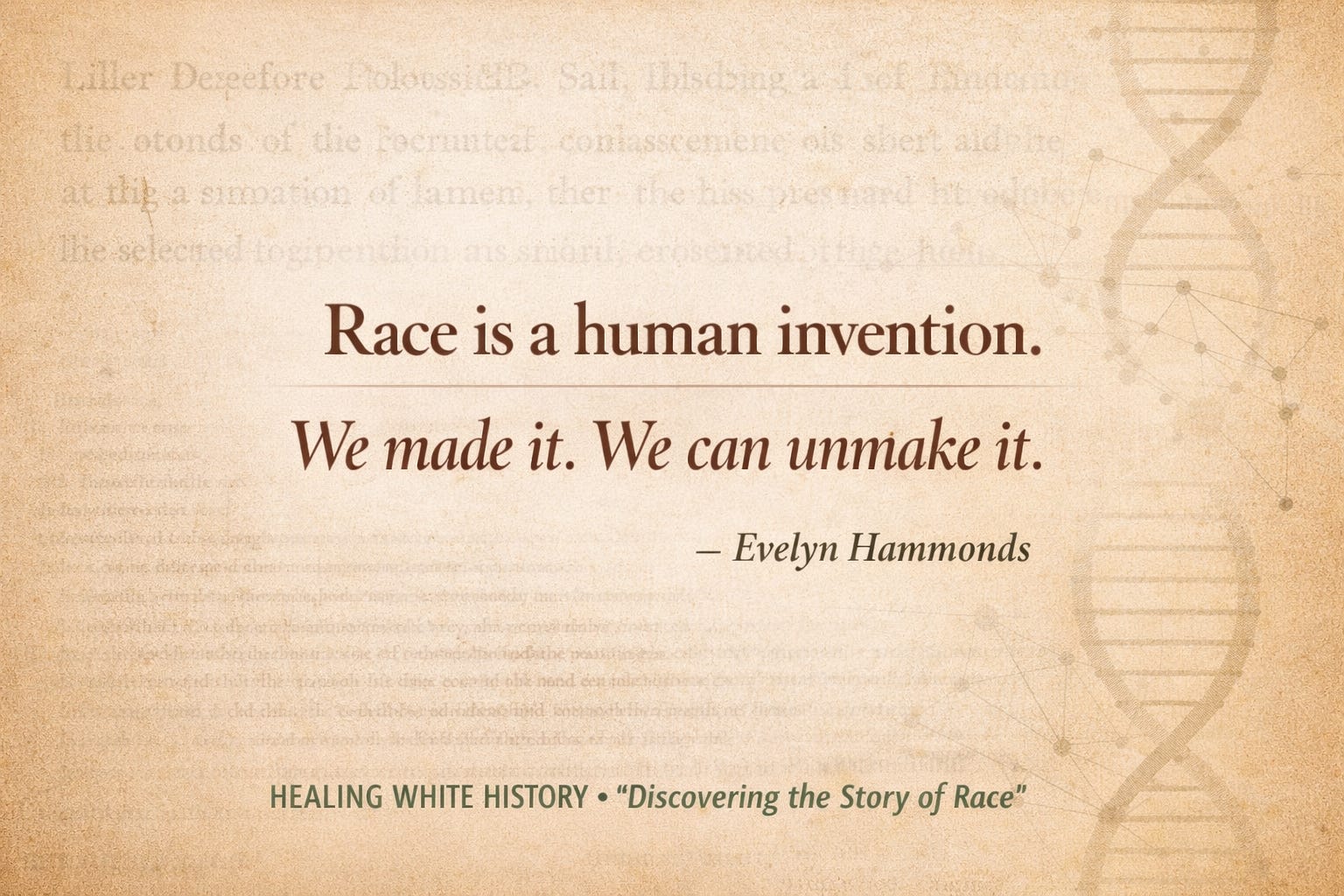
But, I also took heart from the closing words of the first episode of Race: The Power of An Illusion , by Dr. Evelyn Hammonds, a Black historian of science and former dean at Harvard College. She said, “Race is a human invention … We made it, we can unmake it.”15
If race is a story, then we can write a new one. And that’s why I decided to write a book and create this project.
Please subscribe to follow the arc: truth → healing → transformation & repair. And help this book reach a wide audience by sharing with someone who’d value it.
Join the conversation : Drop a comment below:
What stories has your family passed down about your ancestors? Have you ever wondered (or researched) what stories remain untold?
How can we unmake the story of race?
I read and respond to every comment.
New here? Catch up on what you’ve missed:
The Slave Trader in My Family Tree
Confronting My Racist Ancestors: The Method
Thanksgiving, the Wampanoag, and My Puritan Ancestors
Confronting Charley
“How Can I Do This Without Records?”—A Reader Asks
The Bible, the Skull Book, and the Curse of Ham
They Burned the Alamo Express
From Convict Leasing to Mass Incarceration
1 Content Note: The title of the cited source contains a racial slur. Rev. Thandeka, “Today’s White [N-word]s Part 2: ‘White-Skin Privilege’ Exposed” (2019) https://revthandeka.org/todays-white-niggers-part-2 (accessed Oct. 8, 2025).
2 Id.
3 Id.
4 Mary Watkins, White Work and Reparative Genealogy: Reckoning with Ancestral Debt as a Path to Racial Reparations (Kindle Ed. 2025) at 66.
5 See Ibram X. Kendi, Stamped: From the Beginning: The Definitive History of Racist Ideas in America (2016) at 18 (“All in all, ethnic and religious and color prejudice existed in the ancient world. Constructions of races—White Europe, Black Africa, for instance—did not, and therefore racist ideas did not. But crucially, the foundations of race and racist ideas were laid”).
6 Thandeka, supra. The new privileges for the indentured servants included: a) small grants of land when their contracts of servitude were completed, b) making it illegal for owners to whip the white-skinned servants while naked, and c) taking private property from the blacks and granting it to the new whites. Id.
7 Heather C. McGhee, “Bacon’s Rebellion,” in Four Hundred Souls, A Community History of African America 1619-2019 , Ibram X. Kendi and Keisha N. Blain, eds. (2021) at 53.
8 Race: The Power of An Illusion , Episode 1, “The Difference Between Us,” Transcript https://newsreel.org/transcripts/race1.htm (accessed Oct. 8, 2025).
9 Id.
10 Byron Reese, Stories, Dice, and Rocks That Think: How Humans Learned to See the Future – And Shape It , at 65 (2022).
11 Id. at 69-84 (chapter entitled “What Makes a Story?” in which Reese provides evidence that humans are the only species that can: 1) plan for the distant future and conceptualize the past; 2) understand and acknowledge the viewpoints of other creatures; and 3) understand causal chains, all of which are necessary to creating stories).
12 Content Note: The title of a cited source in this note contains a racial slur. Ijeoma Oluo, “Whipped For Lying With a Black Woman,” in Four Hundred Souls, A Community History of African America 1619-2019 , Ibram X. Kendi and Keisha N. Blain, eds. (2021) at 11. This judicial decision to punish Hugh Davis in 1630 came 46 years before Bacon’s Rebellion, which Rev. Dr. Thandeka described as the birth story of “race.” Thandeka is largely correct about the importance of the rebellion, but the Hugh Davis decision and other examples of legal anti-blackness demonstrate that the story of race developed gradually. The Hugh Davis decision in 1630 is an example of a court imposing punishment on an “ex post facto ” basis for a crime that had not previously existed – “defil[ing] his body by lying with a negro.” Today, of course, the Constitution prohibits such ex post facto punishments. But the Constitution wasn’t around to protect Hugh Davis in 1630.
The Virginia legislature – known as the General Assembly – first passed a statute creating racial categories in 1639, when it excluded Negroes from a mandatory requirement to join the militia and be provided firearms and ammo. Virginia Act X (1639). The General Assembly passed several additional anti-black statutes before Bacon’s Rebellion in 1676. But after 1676 the Virginia legislature ramped up the passage of both anti-black laws and creation of various privileges for “white” people. See generally Rev. Thandeka, “Today’s White [N-word]s Part 2: ‘White-Skin Privilege’ Exposed (2019) https://revthandeka.org/todays-white-niggers-part-2 (accessed Oct. 8, 2025).
13 Oluo, supra , at 12.
14 Id. at 13-14.
15 Race: The Power of An Illusion , Episode 1, “The Difference Between Us,” Transcript, supra .

bottom of page