top of page
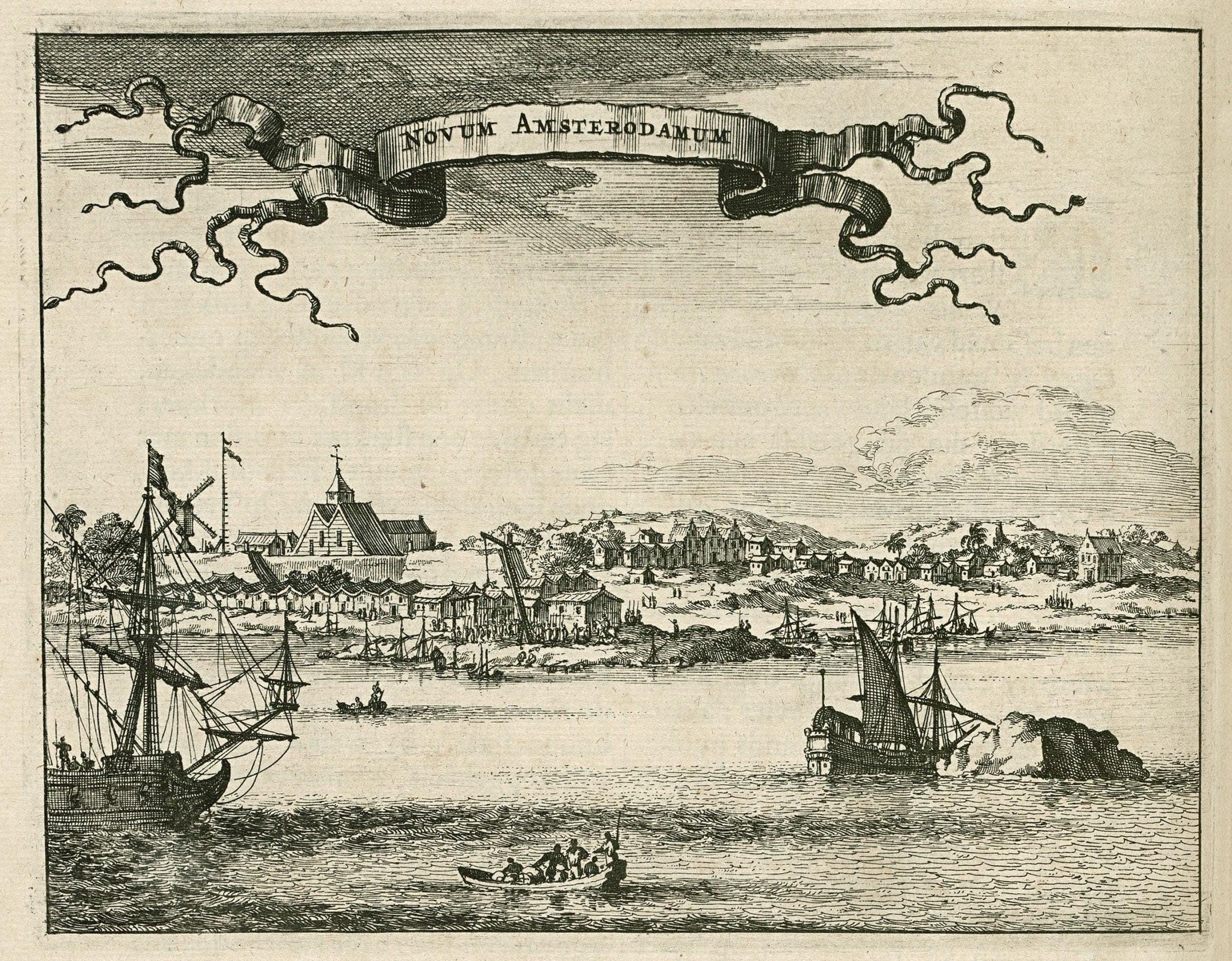
Lenape homeland. Today, it’s Manhattan.
Editor’s Note: This is one from the Substack archives — an excerpt from one of my favorite ancestor conversations in the book manuscript.
Content Note : References to mass dispossession and death of Indigenous people.
New Amsterdam, May 1649
“Steven, you told me that you believe that the people of your nation have stolen to become rich. Obviously, you believe that they have stolen from the Indians, yes?”
My tenth-great grandfather looks me straight in the eye.
I don’t blink. “Yes.”
“This seems very important to you. I just want to tell you – if this belief of yours comes from this view that the Indians did not know what they were selling, then you should change your belief. That is not theft. That is not unfair. It is not wrong, and it is not cruel.”
***
Upon arrival, I’m inside in a fairly dim room. But the first thing I notice is the sound of heavy rain. I’m sitting on a bench at another long wooden table, not unlike the one where I sat in Hadley.1 There are several such tables crowded into this room, which is clearly the common room of the tavern. The room itself is much smaller than I had expected – only about 24 feet by 18 feet, with a low, smoke-stained ceiling that I would guess is less than 7½ feet high. Here also, as in Hadley, a central hearth dominates the room. From the hearth, I smell the day’s stew, already simmering in a large pot sitting on a grate over the fire.
I close my eyes for a moment to lean into the surreal. Here I am in lower Manhattan – on Broadway – where I’ve been many times before, to visit my family, who were here before it became New York.
I’m here at 8 a.m., because I wanted to talk to Abraham Van Deusen before his business picked up. My ancestor Abraham is one of New York City’s first tavern owners. However, he has also played other important roles in this colony, run by the Dutch West India Company. He came here as New Amsterdam’s first official miller.2 Later, as an elected member of both the “Twelve Men,”3 and then the “Eight Men,”4 he was one of Manhattan’s first city council members, although both groups had only advisory powers.
As I’m taking in the room, a child of about 12 approaches me and asks me if I would like a drink. “Yes, please.” Moments later, he brings me a watered-down beer.
After I sit for a few moments to think about what questions I’m going to ask him, Abraham opens the door behind the bar, and walks into the room.
“Steven!” Abraham briskly makes his way to my table. He’s an inch or two shorter than I am – about 5’6” – wearing a linen shirt with gathered cuffs, a fitted jacket, tailored wool pants, stockings, and some clunky wooden clogs. He is 42 years old. His oval face has some smile crinkles, but is otherwise unlined, and his thick, reddish-brown hair is parted to the side and cut relatively short – just covering the tops of his ears. He wears a mustache, and – you guessed it – a “Van Dyke” beard.
“I am so sorry to keep you waiting. One of the cider barrels spoiled overnight, and I had to empty it.” He gives me a small smile. “The mill doesn’t turn without the miller, eh?”
Abraham smiles. “Shall we break our fast while we talk?”
“Perfect. Thank you.”
Abraham heads for the stew pot hanging for the hearth, ladles us big servings in stoneware bowls, then sticks a wooden spoon in each and brings them to the table.
He bows his head and offers a quick prayer. “O Lord our God, we thank Thee for this food, which Thou in Thy mercy hast provided. Give us grateful hearts, and strengthen our bodies this day to serve Thee in all our labors. Bless the work of our hands, guide our thoughts, and keep us from sin. In Jesus’ name we pray, Amen.”
“Amen.”
The stew – made with bacon or salted pork, and seasoned with fresh rosemary and thyme – is far more flavorful than the Russells’ hasty pudding. And, as in Hadley, I find myself pretty hungry.
I start with a mostly-rehearsed bit I used in Hadley. Maybe I’m creating my own ritual.
“Thank you so much for welcoming me to your home. My name is Steve Baughman Jensen, your direct descendant. I don’t really know how our encounter has come about or why it works, but I know you have somehow been made aware of who I am and who I am to you. But, just to confirm, I will not be born until more than 300 years from now, in 1967. Eleven generations of your descendants have lived and died between you and me.”
Abraham nods. “I understand. I am honored you have chosen to speak with me.”
“I’ve come to understand more about you, and to understand more fully the context of how my family and my nation has become what it is in my time.”
“Which nation do you speak of, Steven?”
“Some time in your lifetime, England will conquer this colony. Then, one hundred and twenty-eight years from now, the colonists will successfully revolt and then create a new nation-state, called the United States of America. That nation-state will grow enormously large and powerful. In my time, more than 340 million people live in this nation, which spans across three thousand miles of fertile land.”
Abraham frowns. “I know the fact that you are here means that at least my oldest son survives this English conquest.”
I smile in reassurance. “All of you survive. You go on living here. And your descendants continue to thrive today. Many thousands of them.”
Abraham looks thoughtful. “What you have told me is amazing. Thank God that our family survives and thrives. But, the new nation you describe. It is difficult to fathom.”
I nod. “In many ways, I think the nation I call home – the United States of America – has been very amazing. But some of the same things that allowed that nation to grow rapidly and flourish economically came about because this country, and its institutions, have been very cruel.”
“What do you mean?”
“I mean that many of the people and institutions who have had power – they took it unfairly. They stole it. Their theft was violent, and it has caused devastation for hundreds of years on the descendants of the people from whom they stole.”
Abraham looks thoughtful. “Throughout history as I understand it, stronger men have always taken from the weak. Maybe it would be better if they did not, although I am not certain that is so. But I believe this has always happened.”
“I think you are probably right about history. But might does not make right.”
“Maybe you are right, Steven. My understanding of Christ’s teachings would agree with you. But… in my experience, God’s word and men’s will often have little to do with each other.”
“I agree. And, I would add that men’s will is often used to reshape God’s word.”
Abraham smiles. “Just so.”
More people have begun trickling into the tavern, despite the rain. Abraham does not appear to notice. His eyes remain focused on me.
“Tell me about your relationship with the people you call ‘Indians’ since you arrived here.”
His eyes turn downcast, and his shoulders slump. The Russells are not my only ancestors whose internal narrative about indigenous people has been dramatically altered by escalating violent conflicts. “During the years of Kieft’s War, the Indians terrorized us. And we frightened them right back. And killed them. We killed many. The war was so ugly in every way. Barbaric. I felt differently about the Indians after that war. It should never have happened. But it did, and my relationship with Indians has never been the same since then.”
“You opposed Kieft’s War?”
“Yes. Most of the other Twelve Men and I strongly opposed Kieft’s plan to wipe out the Lenape. Kieft was bloodthirsty. He ordered the murder of innocent women and children. But our opposition to Kieft was not about saving the Lenape. We wanted to save ourselves. We knew that war would be terrible. And terrible is exactly what it was. So many homes were burned. So many women and children had weeks of sleepless nights. And, yes, so many of their people were slaughtered.”
As I sit with Abraham, only four years have passed since the end of Kieft’s War. Its emotional residue remains thick. “First, thank you for taking the stand against Willem Kieft. That was courageous. I am proud that you did that. Second, how do you feel about Indians now?”
Abraham grimaces. “I have no single feeling. I feel disgust. I feel fear. I feel anger. And … I feel shame as well. That war should never have happened.”
“Do you trade with Indians now?”
“Oh yes. If you stay here all day, you will likely see some of them in this tavern. I am a businessman. I can put aside my feelings and trade with those who offer me value.”
This comment makes me consider how, for centuries, the story of capitalism – we exist in order to create profit – has often led businessmen to ignore other narratives and commitments – whether religious, political, or social.
So I pivot to a related topic. “Twenty-three years ago, a representative of the Dutch West India Company purchased this land, where New Amsterdam is now, from the Lenape. He paid the Indians the equivalent of 60 guilders.5 In my time, this village, on this land where we are now, has become one of the biggest, richest, and most powerful cities in world history. More than one million, six hundred thousand people live on this island in my time. The value of the land in my time is at least 160 million times the amount that the Company paid. Was that a fair trade?”
Abraham’s brows knit and his mouth twists. “I don’t understand. You seem to suggest that, because of what happened later, the trade was not fair. But that is not the test for what is ‘fair.’ The Company did not lie. They did not trick those Lenape. The Lenape knew the land and its value far better than my Dutch fellows did. And those Indians chose to sell it for an agreed price. How is that not fair?”
I nod. “I understand your point. But, in my time, many people – many scholars of history – believe that the Lenape and other Indians did not think that they were selling the land for all purposes and all time. The Indians have a different understanding of land and its relationship to people than the Dutch. They thought they were selling the right to share the land – the right to use and occupy it, while they continued to use and occupy it themselves. Many of them stayed here on the island after that ‘sale,’ yes?”
“Yes,” Abraham nods.
“If the Indians thought they were selling only a temporary right to share the land, does that change your mind about whether the transaction was fair?”
Abraham pauses. He takes a spoonful of now-cooled stew, and chews on the question. He swallows, takes a sip of cider, and looks me in the eye. “No, Steven. The deal was fair. There were no tricks. No lies. The Indians never told the Company that they thought they were selling only some type of temporary right. And the Company allowed the Lenape to continue to live here as long as they caused no trouble and did not interfere with our settlement. The Company’s generosity does not help your argument. The scholars in your time are wrong.”
I tilt my head. “Is it your experience that the Company is generous ?”
He laughs aloud. “You are sharp, Steven. The Company allowed the Lenape to stay on the land because their trade and their knowledge were valuable.”
I nod. I’m thinking about moving onto the next topic, when Abraham interrupts my thoughts.
“Steven, you told me that you believe that the people of your nation have stolen to become rich. Obviously, you believe that they have stolen from the Indians, yes?”
“Yes.”
“This seems very important to you. I just want to tell you – if this belief of yours comes from this view that the Indians did not know what they were selling, then you should change your belief. That is not theft. That is not unfair. It is not wrong, and it is not cruel.”
I take a deep breath. There’s so much to say. But how best to say it?
“I understand, Abraham. I don’t agree with your perspective about the sale of this island where we are right now, but I understand it. And there are many other similar sales that have taken place already, and many dozens, hundreds, or thousands of others that will take place later. All of those ‘sales’ of land share the same issue. But even if I were to agree with you that all of those ‘sales’ were fair transactions for the reasons you have shared with me, that would not change my view that my nation has stolen from the Indians. And it certainly would not change my mind about the cruelty.”
“Why?” he asks.
“For many, many reasons. First, the people and institutions of my nation lied to the Indians over and over again. The government of my nation reached hundreds of treaties with Indian tribes, and – eventually – the government broke all of them. My government cheated the native people of this country every single time. Out of greed, and because my government had the power to get away with it.”
Abraham’s jaw drops. “I agree, Steven. That is wrong.”
“Thank you. And I have not yet gotten to the cruelty part. The European settlers of this country, together with the government, eventually slaughter millions of Indians. Millions of others die from diseases carried by the settlers. With violence, they force Indians off their native lands. They march the Indians – men, women, children, and elders – thousands of miles on foot. Huge numbers die on the journey. My government forces them to live together in small pockets of land far away from their homes, which the government calls ‘reservations.’ And, all along, my government – and the people of this nation – tell themselves that the Indians are enemies of God, and that these cruelties against Indians are all well-justified.”
I look at Abraham. I have his full attention. I keep going.
“Throughout most of my nation’s history, the European settlers who dominate my nation’s culture have told the story that the Indians are inferior to them, that they are dangerous savages, and they got only what they deserved. In my time, it has only been in recent years that many people – but still not everyone – have begun to reexamine these notions and this history, and come to a different conclusion. That is part of why I am here talking to you. I want to know and understand better my own family’s role in this history.”
Abraham looks away.
______
Join the conversation: Drop a comment below:
When you hear ‘stolen land,’ what do you think people should do next —learn, pay, return, advocate, something else?
Can a harm this large ever be repaired?
Please subscribe to follow the arc: truth → healing → transformation & repair. And help this book reach a wide audience by sharing with someone who’d value it.
1
2 https://en.wikipedia.org/wiki/Abraham_Pietersen_van_Deusen (accessed Jan. 5, 2026).
3 Historical Society of the New York Courts, “The Twelve Men and Director Kieft’s Indian War,” https://history.nycourts.gov/about_period/twelve-men/ (accessed Jan. 5, 2026).
4 Historical Society of the New York Courts, “The Eight Men and the Remonstrance of the Manhatas,” https://history.nycourts.gov/about_period/eight-men/ (accessed June 25, 2025)
5 https://en.wikipedia.org/wiki/New_Amsterdam (accessed Jan. 5, 2026).

bottom of page