top of page
It’s only recently that I learned to talk to trees.
They speak to me of resilience.
Healing White History is a reader-supported publication. To receive new posts and support my work, consider becoming a free or paid subscriber.
Here in Dallas, the drought continues. Sixty days without measurable rain. The record number of September days hitting 100 degrees had been eight. We are now at 12, and this month is not yet half over.
Still, I walk. Four miles, every other day.
I walk a paved trail along a creek near our house, which is barely a mile from downtown Dallas.
On my trail I pass hundreds of trees. Dozens of varieties.
In my ears, songs of connection to earth and humanity call me to return to my body. To see, feel, smell, taste, and hear. To smile. To breathe.
I see the trees.
They are scorched. Wilted.
But also green and vibrant. Often both in the same tree.
Some are dead or dying. Others have the temerity to flower.
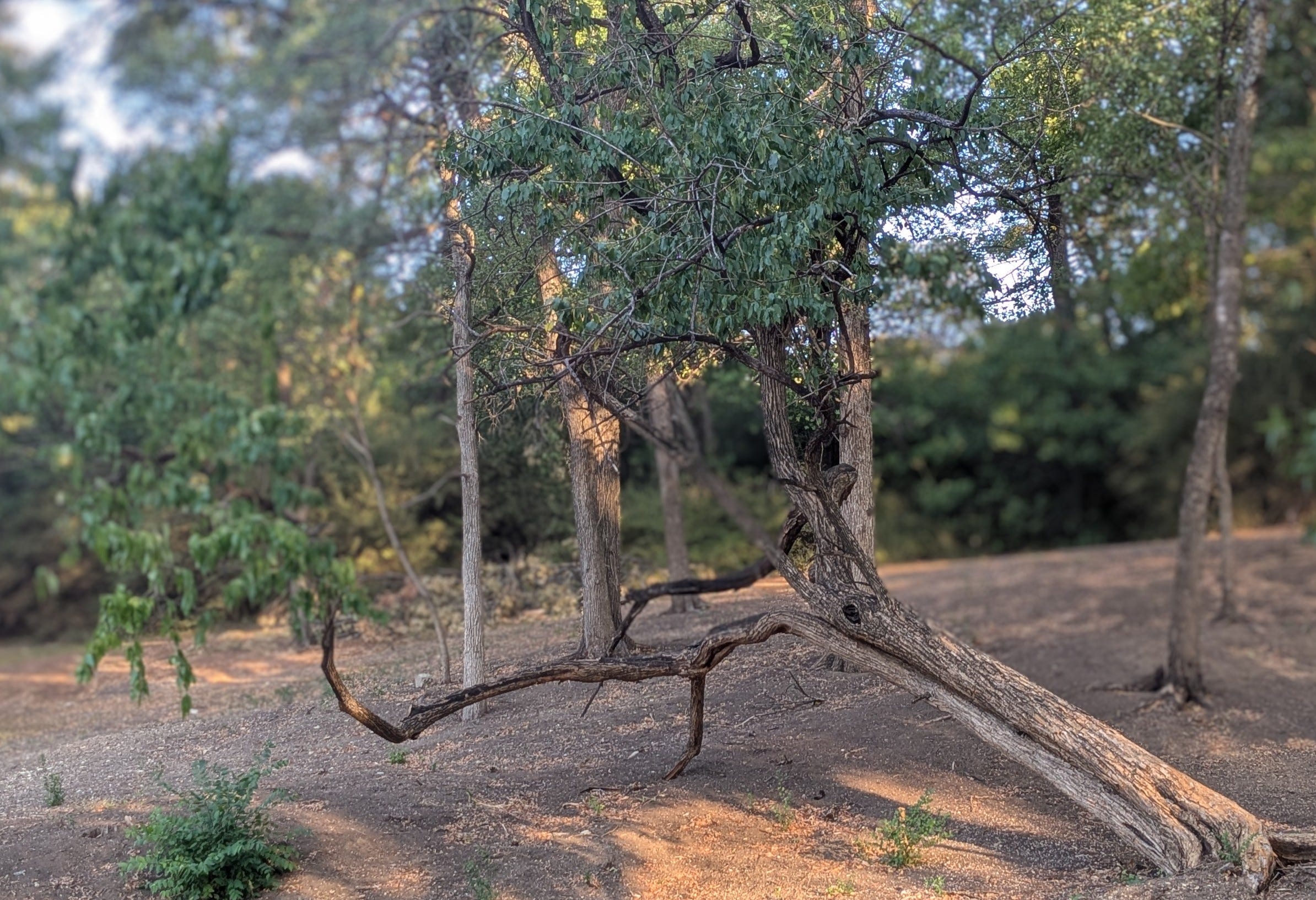
Many sacrifice some part of themselves so that the rest may survive. Others, like this one on my path, appear to give up entirely – shedding not just a limb, but snapping at the main trunk.
This tree in my own backyard did the same.
Back home, watching “The Hidden Life of Trees,” I learn. Trees communicate. Families of trees nourish each other in times of drought and disease. They coordinate when they flower – sometimes across hundreds of miles. Mycelial networks of fungi help trees transmit information about insects, drought, and other dangers – often across miles. They protect themselves and each other from specific parasites, sending chemical signals of danger. Responding with chemical defenses that make the trees unpalatable.
Even after one “tree” falls, another may emerge from its stump. The same roots.
Nature replants its own trees after death. Even after clearcutting or devastating fire, a forest can often remake itself. It just takes time. And being left alone.
Part of me finds all of this incredible. But not the part that talks to trees.
Strolling past giant oaks, I wonder how many family, friends, and neighbors they have helped to survive. How many do they feed now?
These two live oaks are partners. It’s difficult to tell where one begins and the other ends.
Another tree grows sideways along the ground. Bent, but unbroken. I call that one “Resilience.”
I have been conditioned by a culture that has taught me that trees – and the rest of the earth and its creatures – are “resources.” Something to be consumed. Extracted, mostly without care.
That conditioning runs deep. I still rarely think about where the wood I consume has come from. The beams of my house. The thousands of boxes of office paper from a lawsuit. And on and on.
But now I see the trees. At least sometimes. And they speak to me. Sometimes I listen.
I talk back, though rarely out loud. I feel like they still hear me. Mostly I send short messages: “Thank you.” “Hello.” “Wow.” “I’m sorry.”
I imagine more of a conversation with my favorite tree – an enormous live oak that I’d guess is 150 years old. I call him “Old Man.” If I’ve misgendered him, he has not informed me. He does, however, remind me that I am actually the old one. He will remain, standing and growing, long after my body has returned to dust.
I call him “Old Man”
My culture – the one that consumes – long ago consumed the Indigenous people who had lived here first, for thousands of years. But, like so many of our stories, even that admission of guilt carries a lie. We white people tried very hard to swallow the First Americans. But they did not comply.
Genocide, disease, war, and intentional cultural destruction. During the “Boarding School Era,” white Americans repeated the slogan “Kill the Indian, Save the Man,” as if destroying the Indigenous language and way of life was something to be proud of.
And still, like the trees in this drought, Indigenous people have survived. And they are reviving the language and culture that we white people worked so hard and long to destroy.
Before Europeans arrived on American shores, millions of Indigenous people lived here. 1 Less than 250,000 remained in 1890. 2
And today, millions of Native Americans live here once again. 3
Native Americans have been revitalizing their cultures and languages – tribal language immersion academies, museums, popular films, television, art, and poetry.
We should not be surprised at this resilience. There are at least 574 Native American tribes, each with its own culture and traditions. Many share a deep reverence, spiritual connection – and identification – with the earth. With land, animals, and plants.
Indigenous people have learned many things from those connections. Including how to survive and thrive after severe adversity.
Many Native American traditions celebrate kinship with trees and forests. As I wrote a few weeks ago, Indigenous stewardship, including “cultural burning” practices, have helped protect forests for thousands of years. 4 While I learned that wood is but a resource to be consumed, many Indigenous traditions taught that trees, land, and all living things thrive in partnership.
Trees live in community with each other. Communicating, sharing, supporting, nurturing.
We white folks seeking to be “allies” have often failed to build that into the work. We have not created sustaining relationships across racial lines. We have not nourished and nurtured one another with a culture that not only encourages work but fosters joy. Just as plants need sugars from photosynthesis to survive, we need joy to fuel the work. And we need to make finding that joy a part of a newly-created culture of white people working for racial justice. We have so much to learn. From Black folks. From Indigenous people. And from the trees.
Talking to the trees may not be for you. But learning from the resilience of nature is for all of us.
Please subscribe to follow the arc: truth → healing → transformation & repair.
1 Historical estimates of the population of North America before Columbus’s arrival in 1492 vary from 2 million to 18 million people. Kevin Jon Fernlund, “The Myth of Millions. Rethinking Hispaniola Before Columbus,” History Reclaimed (May 6, 2026) https://historyreclaimed.co.uk/hispaniola-Indigenous-population/ (accessed Sept. 14, 2026).
2 https://www.nlm.nih.gov/nativevoices/timeline/379.html (accessed Sept. 14, 2026).
3 In 2020, the U.S. Census tracked 9.66 million people – about 2.9% of the U.S. population – who identified as American Indian or Alaska Native (alone or in combination with other races or ethnicities). That same Census found 3.7 million people – 1.1% of the population – who identified as American Indian or Alaska Native alone ( i.e. , not combined with any other race or ethnicity). https://www.census.gov/library/visualizations/interactive/race-and-ethnicity-in-the-united-state-2010-and-2020-census.html (accessed Sept. 14, 2026)
4

bottom of page