top of page
Editor’s Note: Of the six conversations with my ancestors in my draft book manuscript, this one is my favorite. This post from the archives comes in longer than most, but it’s still just an excerpt — I have to give you some reason to still want the book. As this post drops, I’m traveling home from a vacation across the Atlantic. Next Tuesday, I’ll be back with a new essay. Meanwhile, I hope you enjoy this piece from the manuscript.
Comanche, Texas, October 1932
It’s early afternoon, sunny and about 70 degrees. I’m standing outside a large, Victorian home. It’s limestone, with two stories, and a steeply-gabled roof with a turret above the front entry. I think about the Lyman’s parents’ tiny home in St. Mary’s which I visited in 1872,1 and marvel at how Lyman’s lifestyle has changed since then. And I didn’t see the even smaller and more primitive house in Helena, where my third-great uncle Lyman grew up as Charley and Emeline’s oldest son.
Lyman’s niece, my second-great aunt Alice, opens the door, smiles widely, and immediately brings me in for a bear hug. She releases me and motions inside. “C’mon in, honey. We’ve got sweet tea and lemonade ready. I can make some coffee if you want it. I’ve only been here for a bit, but Uncle Lyman’s already gotten himself into storytelling mode, so your timing is pretty good.”
I can’t help but return the smile. “Yes, Ma’am. Thank you very much.” Alice, 43 years old, is wearing a modest floral dress with a mid-calf hemline. She’s tall and broad-shouldered, with gentle eyes that twinkle in a way that reminds me immediately of my grandmother Happy.
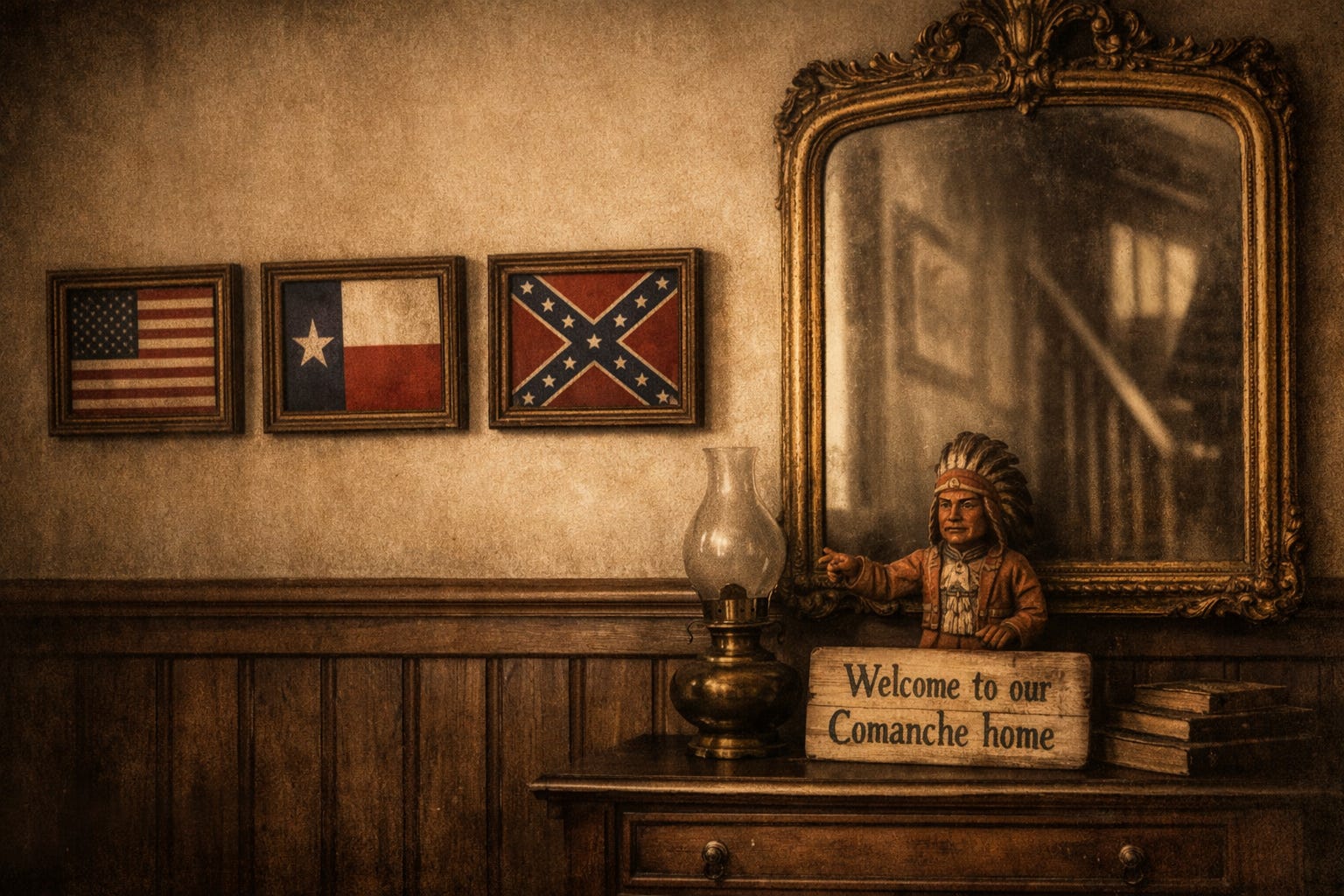
In Lyman’s entry hallway, I find dark wood paneling evocative of stuffy, exclusive men’s clubs, with a gilded mirror hanging above a console, where a small, caricatured wooden Native American figure points to a sign, “Welcome to our Comanche home.” In front of us, to the left of the hallway, is a staircase. Beside the mirror, on our right before the stairs, hang three small, framed flags – the Stars and Stripes, the Texas flag, and the Confederate battle flag. My anxiety level ticks up a few notches. I knew what I was walking into, but the rebel flag provides a very concrete reminder of how difficult this conversation might be.
Alice leads me past the stairs and down the hall. We pass a formal parlor to our right, then enter a swinging door to a dining room, where 82-year-old Uncle Lyman sits at a large, mirror-polished, formal wood dining table, sipping a tall glass of iced tea.
When he stands to shake my hand, I can see he’s a few inches taller than I am – 5’10” or maybe slightly shorter. His beard is long and mostly white, but his back is straight and his gray eyes are piercing.
“Nephew Steven! I’m delighted to make your acquaintance. Welcome to our not-very-humble abode. I am hoping God will forgive me the sins of wastefulness and pride in owning such a splendid old house and putting just two tiny old people to live in it. It’s good and comfortable for sharing a visit with family, though. Pardon me for not giving you the grand tour, but I save up energy after doing my chores in the morning. Having a few afternoon visitors is just what my soul needs to lift any passing guilt that might shadow me for sitting a spell, which is exactly what I would be doing, even if you were not here.”
I laugh. I may need to be pretty aggressive just to get a word in. And on cue, Lyman starts talking again.
“Alice – my wife Alice, I mean – is off to a Ladies’ Auxiliary meeting, or something of the sort. It may not surprise you to learn she takes advantage of every opportunity to leave my company. I have been informed that my bubbly personality can have the tendency to wear on folks, after a while. Anyways, she sent her love and her regrets for missing you. She made the drinks and the sweets for us before she left. Now I am going to sit back down, which sometimes requires a good while to do. Maybe you can start to talking while I get to it. Just be sure to keep your damn voice up. I’m half deaf. And the other half ain’t too smart.”
“Yes, sir.” I think Lyman’s a lot like his father – a bit louder, a bit more gregarious and funnier, and probably far better-tempered. But still, a lot like Charley.
Lyman smiles. “You came to the right place, Nephew. The two of us are the true lovers of history in this family. I ‘spect Alice and I will show a fair bit of enthusiasm. Might be that you need to interrupt us every now and again. Just don’t kick me in the right knee. That one acts up every now and then – but generally only when I try to use it.”
“Yes sir. Left knee only, then.”
Lyman nods. “I see you are a quick study. Now, what do you want to ask us?”
I turn to my grandmother’s Aunt Alice (Lyman’s niece). “I have a lot of questions for you, but if you don’t mind, I want to start with a few for Uncle Lyman.”
She laughs. “Honey, I am on the edge of my seat to hear what happens between the two of you. Age before beauty. Y’all take your time.”
I decide to start with something easy and close to Lyman’s heart. “OK, then. Uncle Lyman, I know you’ve been a Freemason pretty much your entire adult life, yes?”
“Your information is correct, young man.”
“Tell me why.”
“Well, much as I love hearing myself talk, I find that talking is even better when I can get someone besides myself to listen in. And, occasionally, I even enjoy hearing what those other people might have to say. I have been to a meeting at my Masonic lodge every month for more than 60 years. I have been to a few different lodges over the years because I moved as a young man, but I would guess I have missed only a dozen or so meetings in that entire time – it is a rare year that I miss one. I go for the fellowship, son. And because I believe in the principles.”
I nod. “What principles are you talking about?”
Alice interrupts. “I think Uncle Lyman and the Masons especially appreciate the principle of not having to listen to women speak their mind.”
Lyman laughs. “My niece and I have had some lively conversations about the fact that the Freemasons do not admit the fairer sex. I keep telling her that she would not last 10 minutes in one of those meetings, what with the smell of the cigars and the farts from a bunch of old men.”
Alice lifts a brow. “I could bring a fan. And many of the ladies I know are capable of overcoming far more than the smell of tobacco and flatulence.”
Lyman laughs. “I do not doubt it, young lady. You know I never have, at least when it comes to you. Now, let me get back to answering our nephew’s question. I fear I now have to ask you to say it again, Steven. My memory works just about as often as my right knee.”
I shake my head and smile. “Yes, sir. I just asked which principles of Freemasonry you believe in?”
“Ah. I think the most important one is the Golden Rule. Do unto others as you would have them do unto you. We also believe in honesty, duty to community, and a Supreme Being. And we believe in loyalty to the United States of America and the principles of democracy for which this country stands.”
Now I need to start getting to the point. “Thank you. That’s helpful. Now, you are also a member of the Sons of Confederate Veterans?”
“Yes.”
“What is your understanding of the guiding principles of that group?”
“Nephew, both you and I are lawyers. As a lawyer, I have a pretty good nose for smelling a trap. Are you trying to set a trap for me?”
I smile. “Uncle Lyman, if there is a trap in that question, then it comes from the principles themselves, not from me. I’m just asking what the principles of the SCV are.”
Alice fidgets in her chair. As a devoted member of the United Daughters of the Confederates, she is paying very close attention.
Lyman nods. “Pardon me for just a minute. I believe I can shortly put my hands on a cheat sheet.”
At this point Lyman walks out of the room toward the parlor, where I had noticed some bookshelves. He returns after a few minutes, holding a small booklet, titled The Constitution of the United Sons of Confederate Veterans . Lyman flips to one of the first pages, reads for a few minutes, then looks back to me. “All right, Nephew. Here you go. Here is how I understand the purposes of the Sons of Confederate Veterans: to unite Confederate descendants; cultivate friendship; encourage spreading the South’s true history; collect historical data and relics; care for disabled veterans, widows, and orphans; erect monuments and mark graves; and instill veneration for Confederate leaders and principles into descendants.”
I nod. “Thank you, Uncle Lyman. Now, can you tell me in a nutshell, what is meant by the ‘South’s true history?’”
Lyman pauses, but Alice jumps in to help him. “I can tell you, Steven.”
“Thank you, Aunt Alice. Go right ahead.”
“We call it the ‘true history of the South’ because, after the Civil War, many northerners spread lies about the War Between the States, the reasons the South left the Union, how the South conducted itself before and during the war – including in the treatment of slaves, and what the slaves’ attitudes were toward their masters.”
“Can you share with me specific examples of the ‘lies’ you’re talking about?”
“Of course. For example, many northerners claim that the South entered the war solely to defend slavery. That’s not the case. Slavery was an issue, but the primary reason that the southern states seceded was because the federal government was trampling those states’ rights as sovereign entities.”
I look at her with brows raised. She has paused to let me respond, and I do. “Was there any particular states’ right that was driving the complaint that the federal government was trampling states’ rights?”
Alice’s nostrils flare. “One was slavery. But it was the general principle of independent sovereignty, as established by the 10th Amendment of the Constitution, which drove the states’ decisions to leave the Union.”
I am not going to let her move on before we have hashed this one out. “And were the southern states always faithful to the idea of the independent sovereignty of each state, over the federal government?”
“Of course.”
“Ah. I assume, as a historian, you are familiar with the Fugitive Slave Act of 1850?”
“Yes.”
“In the Fugitive Slave Act, the federal government commanded northern states to turn over any fugitive slaves that had escaped and fled to a free state. The Act provided for severe criminal and civil penalties for anyone in a free state who harbored fugitive slaves or who interfered with their capture. That federal law explicitly said that local laws relating to personal liberty could not be used to get around the Act. What was the position of the South with respect to the states’ rights at issue in the Fugitive Slave Act, Aunt Alice?”
Alice’s chair scrapes the floor as she sits upright abruptly. “Of course the South supported that law. It was about protecting their constitutional interests in their property.”
Bingo. “And the South’s interest in protecting their property interests in enslaved people was more important than the free states’ rights to decide and enforce their own sovereign laws that would apply in their own states. Right?”
The ice in Alice’s glass tinkles as she fidgets with it. “Right.”
I laugh, with my arms stretched wide, hands upturned. “And you don’t see the inconsistency here?”
My grandmother, Happy, wrote of her Aunt Alice, “For such a jolly woman, Aunt Alice was the most narrow-minded, set-in-her-ways person I ever knew.” Alice was an elementary teacher, and Happy also reported that she would give her students a “Mad Bull” look whenever they were acting out.
And now the “Mad Bull” emerges.
“Those were entirely different situations! The Yankees had no property interest in those fugitive slaves! Lincoln was planning to set the slaves free in the South – and ultimately did do that – without compensating the owners a penny! The Fugitive Slave Act didn’t cost the Yankees a dime, unless they broke the law and got fined for it.”
I sigh. “You actually don’t see any inconsistency, do you?”
“You are damned right I don’t.”
I turn to Uncle Lyman. “Are you ready for your next question, Uncle Lyman?”
“Ready and willing, sir.”
“OK then. I’m going to stick to the same topic. Do you believe the primary reason for the Civil War was slavery?”
Lyman frowns and peers over at Alice. He shakes his head. “Much as I fear what my niece is going to do to me when you leave, I have to admit that war was mostly about slavery.”
Alice scowls. “You better guard that right knee, Uncle.”
“Thank you for the fair warning, my dear.”
I laugh again. “Maybe I better get in-between you.” I look at Lyman. “Is slavery consistent with the principles that the Freemasons adhere to?”
Lyman hesitates. He looks away for at least thirty seconds before turning back to me. “No. As God is my witness, I do not believe that it is.”
Alice stands up. “I thought you were a Baptist? The Baptists have always preached that the Bible supports slavery. Do you reckon you will still be a deacon in your church if I tell your preacher what you just said?”
Lyman looks pained. “I know, my dear. I know. And there are places in the Bible that provide support for slavery. But the Good Book also teaches us that ‘all things whatsoever ye would that men should do to you, do ye even so to them: for this is the law and the prophets.’ It also says, ‘Blessed are the meek, for they shall inherit the earth.’”
True to form, Alice does not give up. “But the slaves were happy. When the Yankee soldiers tried to convince them to leave their families and fight for the Union, they refused, and defended their families.”
I turn to her. “Alice, think about what you are saying. I know that the United Daughters of the Confederacy have been spouting these kinds of stories for decades. But, if it were true that most slaves were happy, why did so many slaves escape? How did slaves react after they finally learned that they were emancipated? On the flip side, who benefits from a story that says that the slaves were happy?”
The “Mad Bull” returns. “Now you are just calling me a liar.”
I shake my head. “All of us want to believe the stories that the people we love and respect tell us. Those stories shape us. It’s natural that you would believe them. But sometimes, those stories just aren’t true. This particular story is not only false, it’s also extremely poisonous. It has led to ongoing suffering, pain, and death for Black people and other People of Color. That suffering continues even in my time.”
Lyman looks at Alice tenderly. “Dearest, think about the Golden Rule. Would YOU have wanted to be enslaved? Even for a day? Even for an hour? You say the slaves were happy. I don’t believe it was so – at least, I don’t think they were happy to be enslaved. But even if they were, making them slaves would violate the Golden Rule, because YOU would not want to be enslaved.”
This finally causes Alice to pause. She says nothing.
I turn back to Lyman. “Uncle Lyman, can you imagine yourself as the descendant of an enslaved person?”
He cocks his head. “I have a very active imagination, young man.”
“If you were descended from a slave, how would you feel when you saw statues of Confederate leaders erected in a public square?”
He does not answer for a very long time. His head is bowed and his eyes are closed. Alice watches him, and her foot taps nervously.
Finally, he looks back up at me. “I have to admit, Steven, I think I may have oversold the limits of my own imagination. The more I tried to put myself in that position, the more I realized that being Negro would have changed every aspect of who I am and how I live in this world. If I were Negro, I do not know with any certainty what I would feel when I saw a Confederate statue. But, I think it would probably be upsetting.”
“Thank you for taking my request so seriously, and for the honesty of your response.” I pause. “Why do you think it would be upsetting for a Negro to see those Confederate statues?”
He snorts. “You do not let up, do you, Nephew?”
I decide to challenge him. “Are you still up for this?”
He straightens in his chair. “You know I am.” Then, he takes a deep breath. He again bows his head. After 10 long seconds, he looks up. “If I were Negro, the Confederacy would stand for slavery. Any Confederate symbol would remind me that my ancestors were not allowed to be free. And it would make me think that the people who put up that symbol or statue do not believe that I should be free, either.”
I am stunned that he got that far. Almost speechless. I look at Alice, who appears distraught. But she remains silent.
I turn back to Lyman. “Thank you.” I hope he understands how much I mean it.
He looks at me. “Son, I have been walking this earth for 82 years. I grew up in a home with a slave Mammy. And when I was 14 years old and thought I was a young man, I lived with a little Negro girl who stayed with my family even after she became free. If you had asked me when you walked in here how I felt about those two Negroes, I would have told you without hesitation that I loved them.”
Lyman pauses to take a sip of tea. He takes out a handkerchief and wipes his brow. He takes another deep breath, then he goes on.
“Both of my parents taught me the Golden Rule when I was very young. And the Masons have been a fundamental part of who I am for more than 60 years. But until about five minutes ago, I do not believe I have ever in my life spent a lick of energy into thinking about what it would really be like to be a Negro.” He looks back up at me, then says, “I reckon I am the one who ought to be thanking you .”
His eyes are dry, but mine are not. I reach out with both of my hands and take his. I hold them there for a few moments.
Alice has been silent for several minutes, until now. Her eyes flit toward her uncle, then away. “Uncle Lyman, that was … something. Something I need to think on.”
I stand up and look at both of them. “I can’t express in words how thankful I am that the two of you have let me visit with you today. Uncle Lyman, your home is beautiful. And so are you, Old Man. Keep thinking about that Golden Rule for me. Aunt Alice, I hope you will think longer about what we have talked about. I appreciate how both of you have been so honest with me today, and listened to me so carefully. Thank you again.”
Alice surprises me, and draws me in for a hug. “Come here, Nephew. You are a good egg, for a Yankee sympathizer.”
Lyman laughs, and also embraces me. “Young man, you can come back any time you like. If you wait too long, I will not be here to greet you. But that will probably make your visit more agreeable.”
As I walk toward the door, the Confederate flag in the hallway reminds me of how big Lyman’s breakthrough was. And a glance at the wooden “Indian” reminds me of one piece of history that we did not talk about, which still bothers me.
I walk out the door, and briefly look around, shaking my head that I am in a town named “Comanche.” I feel shame at what the Comanche ancestors must think of this place now.
______
Join the conversation: Drop a comment below:
White people created the stories of race and white superiority to dehumanize Black people and justify their enslavement. Those false stories persist. How can we break down those stories and create new stories that invite white people to empathize with People of Color?
What stories have you had to unlearn?
Please subscribe to follow the arc: truth → healing → transformation & repair. And help this book reach a wide audience by sharing with someone who’d value it.
I read and respond to every comment.
1

bottom of page