top of page
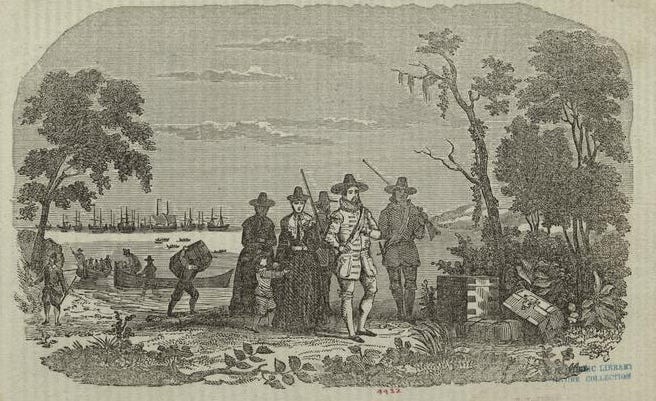
The arrival of John Winthrop at Salem, MA in 1630 — 47 years before this conversation with my ancestors. Winthrop famously delivered a sermon claiming that God had entered a covenant with the colonists to claim this land.
Content note: Repeated period references to Native Americans as “heathens,” “savages,” and “Indians.”
We start today in a place and time we have been before: Hadley, Massachusetts in February 1677. We are in the home of my ninth-great granduncle, Rev. John Russell, Jr. (1626-1692). “Young John” is one of the founders of Hadley, and the town’s Congregationalist minister. Also in the room is his father, John Russell “The Emigrant,” (1597-1680).
As I arrive, the Massachusetts colonists are fighting “King Philip’s War” against the Wampanoag people – the same folks with whom the Mayflower settlers celebrated the first “Thanksgiving” feast 56 years earlier, in 1621.
We join the conversation in mid-flow, after my ancestors received me warmly and then told me what they knew about the story of the “First Thanksgiving.” 1 The conversation has now turned to the current war with the natives. 2
Hadley, February 1677
“Why do you believe it’s God’s will for you to kill these people who were here before you, living peacefully on these lands for thousands of years?”
“Scripture,” Young John answers.
“Which scriptures specifically?”
Young John smiles. I’ve tossed one into his wheelhouse. “Are you familiar, Steven, with the covenant God struck with Abraham, set out in chapter 12 of Genesis?”
“Yes.”
“God promised that Abraham’s descendants would multiply, until they were like the stars in the sky and the sand on the seashore. Most importantly, God also promised that Abraham’s people would inherit the land of Canaan.”
I note the irony of the Puritans’ choice of this story to justify their wars and eventual genocide against indigenous people. 3 Competing interpretations of this same Biblical story have led to thousands of years of ongoing bloodshed, with no end in sight, over who should possess the true “Canaan” – in Israel, Palestine, and Lebanon. God’s covenant with Abraham has proven to be a story with incredible power, but not in a good way.
I decide to spar with Young John, at least for a while. “But this is not the land of Canaan, as you know. That land lies thousands of miles to the east of England, on the eastern shores of the Mediterranean Sea.”
As I could have predicted, my parry does not exactly slow Young John down. “But surely you see the pattern, son? This land IS the new Canaan. The Christians in New England are God’s chosen elect, subject to the tyrannies of King Charles, no less than Moses’s people were subject to the tyranny of Pharaoh. We are the new tribe of Israel. We left our version of Egypt to travel to this wilderness we call New England, where we found these heathen tribes living in our promised land. Ephesians chapter 2, verse 12 calls out those who are without Christ as being aliens from the commonwealth of Israel, and strangers from the covenants of promise. The Indians here are aliens to the covenant and commonwealth of Israel.”
Young John pauses briefly to puff his pipe. But only briefly. I sigh, regretting my scriptural question. Young John continues. “In Deuteronomy chapter 7, God tells the Israelites who approach Canaan that ‘When the Lord thy God shall bring thee into the land whither thou goest to possess it … thou shalt smite them, and utterly destroy them.’ This is God’s command of us in New England. We shall follow His will and smite his enemies, who are aliens from the commonwealth of Israel.”
I try a new tack. “If you are truly the new tribe of Israel, and this land is truly the New Canaan, then why did the Plymouth settlers befriend the Wampanoag in the first place? Why did you feel called to convert them to Christianity? If they were the Canaanites, God’s command would have been the same then as you say it is now – destroy them, right?”
Young John looks sad. “You are correct, Steven. We should never have befriended the savages. We misunderstood God’s will. We repent of that poor judgment. But God’s plan is now clear.”
“As I recall, just a few minutes ago the two of you told me that it was clearly God’s will that the Plymouth settlers allied with Massasoit’s people, because otherwise those settlers might have starved in the winter of 1621.”
Young John’s jaw clenches and his brow furrows. But he breathes through it. “Steven, your challenges are worthy of thought and discussion. But perhaps we can first break our fast together, as family?”
Young John’s response to my anger tips me off balance. But … a quick body check reveals I’m really hungry.
“I’d love to join you for a meal.”
The tension releases. Until after we finish the meal.
I turn back to the Johns. “Gentlemen, please tell me why the Christians’ beliefs about the Indians in New England have changed so much since 1621.”
“Hmm. One moment, son.” Young John turns back to the hearth, where the two pipes had been laid back on the mantle. He grabs both, refuels, hands one to his father, then lights both pipes with another ember.
Then he turns to me. “Steven, have you ever had a stranger come into your community, or your home , with violent intent?”
“I have not. I have imagined it. It must be terrifying.”
Young John nods. “It is that. It is terrifying, horrible, and also highly motivational. I believe it is one means by which God creates transformation.”
I pause, thinking more about Wampanoag raids and the impact of that type of trauma on the settlers’ attitudes toward the indigenous people. Trauma itself is a broken story, replaying in our heads without our permission.
I decide to take a chance. Maybe I can help stop that broken story from playing over and over again in the heads of my ancestors.
“I want to go back to your changing views about the Indians. Just to clarify, you understood God’s will as to the Indians differently after King Philip’s War began?”
Both men nod. “How could we not?” Young John asks.
“You tell me you now understand that God views these natives as Canaanites – aliens to God’s covenant. So you believe God commands you to destroy them. I want you to indulge me for a moment. Please. What if that is not correct? You say the Christians in New England misunderstood God’s will about the Indians fifty years ago, so isn’t it possible you are still misunderstanding God’s will now? What if I told you that the ancestors of the Wampanoag had lived on this land for thousands of years before God ever made His promise to Abraham, and that promise was about a land that is thousands of miles away on the Mediterranean Sea? Can you concede the possibility that God’s promise to Abraham has nothing to do with God’s will toward the natives of this land, who were here long before the time of Abraham?”
The two men look at each other, then back to me. They smoke in silence.
Finally, Young John speaks. “Steven, I feel your heart in this. I do not understand why the lives of these savages are so important to you, but I know that they are. And, I freely acknowledge that I can and do make mistakes. I sin. I misunderstand God’s will, probably every day.” He pauses to puff.
“But you need to understand my heart, as I understand yours. God has spoken to me on this subject on repeated occasions. He has spoken to my community. He has spoken to all the faithful of New England. We are united in God about this. We know that God has commanded us to settle this promised land and to smite the Canaanites who stand in our way. We are not mistaken in this.”
I feel no surprise. But my lack of surprise does nothing to ease the sadness gripping my gut.
_____
Dallas 2026
Today, the Puritans’ belief that God commanded them to kill the “Indians” has been replaced by Christian nationalists’ belief that God commands them to “protect” America from immigrants.
Christian nationalism—also often referenced as white Christian nationalism—might be a misnomer because it has nothing to do with theology or any religious orthodoxy. Instead, with a basis in racialized power dynamics, it is a political framework that places America on par with the Bible’s nation of Israel, regarding the original United States as manifesting God’s intention for God’s chosen people in God’s chosen land. 4
The toxic story my ninth-great granduncle preached in Hadley, Massachusetts still shows up in American minds and American policy today. PRRI polling in 2024 showed that 68% of Christian Nationalists believe in the “Great Replacement Theory” that “immigrants are invading our country and replacing our cultural and ethnic background.” 5 And while most Americans look on in horror at the state-sponsored violence of terrorizing, capturing, and deporting Black and brown people, Christian nationalists cheer in support.
My ancestor relied on misinterpreting Hebrew scripture to justify the fantasy that God commanded them to destroy Native Americans and take their land. Christian nationalists today have moved past scripture to find God’s “commands” in “modern day revelations, that God actively communicates new messages—beyond those written in the canon of the Christian scriptures.” 6 This idea springs from a Christian nationalist movement known as the “New Apostolic Reformation” (NAR). One of the leaders of the NAR is Paula White-Cain, head of President Trump’s White House Office of Faith. 7 According to White-Cain, God told her to work for Trump’s campaign, and that “saying no to President Trump would be saying no to God.” 8
But current Christian nationalists have not abandoned the same misinterpretations of the same scriptures that my ancestor relied on. Just as Young John believed that Deuteronomy chapter 7 meant that God commanded the colonists to destroy Native Americans, prominent Christian nationalists claim that the same text calls for today’s Christians to “conquer” the “Seven Mountains” of government, family, economy, education, religion, arts/entertainment, media. According to Johnny Enlow’s popular book, The Seven Mountain Prophecy , these seven “mountains” map directly from the seven Canaanite nations God directs the Israelites to conquer in Deuteronomy 7. 9
Christian nationalists have used this Seven Mountains mandate to advocate for exactly the types of anti-immigrant policies that our current federal administration has adopted. 10
Meanwhile, at the same time Christian nationalists create new embellishments for the old false story that white Protestants are God’s chosen people in the chosen land of America, they also cherry-pick history to convince us that our country was founded on this same lie.
To be sure, Pilgrims and Puritans like my ancestor Rev. John Russell, Jr. embraced theocratic ideas in the 1600s in Massachusetts. And today’s Christian nationalists are quick to point this out. But 100 years later, the architects of the American Constitution built a new government on principles that explicitly rejected the concept that our government should be based on Christianity or any other religion. Indeed, the Bill of Rights begins with language that leaves no doubt on this subject: “Congress shall make no law respecting an establishment of religion, or prohibiting the free exercise thereof …”
The stories we inherit, believe, and tell make us who we are. I wrote the conversation excerpted above to change the narrative about my family’s role as colonial settlers, and to capture a fuller truth about who they were and what they did. This is the first step of the Truth, Racial Healing, and Transformation (TRHT) framework, which aims to push us toward racial healing and repair of the broken systems that continue to cause harm to People of Color today. 11
When I imagined conversations with different ancestors in the course of this work, I was able to connect with all of them as family. I viscerally felt their love for me. And, unlike many real conversations involving race, in my imagination my ancestors allowed me to push them past their initial defensiveness. They dug deep, and examined whether their attitudes and behaviors toward Black and brown people were consistent with their broader moral beliefs.
Nonetheless, as the excerpt above illustrates, these conversations did not always change them. I couldn’t always change the false stories playing in their heads. And my frustration during those broken conversations echoes my feelings about many of the broken discussions we have as Americans today. Many of which are rooted in the very same false stories.
But we can’t give up just because the work is hard. As I’ve said before and will say again, we, the white allies, cannot just keep shaking our heads and patting ourselves on the back for being the “good white people.”
We need to develop a culture around the work of racial healing and repair. We need to change the narrative to reflect the whole truth, build relationships with communities of color, adopt somatic practices to heal the racial trauma embedded in all of our bodies, and find ways to transform the unjust systems that continue to cause racial harm.
And in the process we need to stop thinking about this work as heroic self-sacrifice. Not only are these transformations our responsibility, but creating a just and equitable society benefits everyone, including us. Creating belonging and community across racial lines allows all of us to become family. To rely on one another. To trust that all of us will lend a hand when it’s needed.
And we all need it now.
Please subscribe to follow the arc: truth → healing → transformation & repair.
1
2
3 I have not found any of Rev. John Russell, Jr.’s sermons, nor any correspondence or other documentation showing directly that he preached that God had “chosen” the Puritans to settle the “new Promised Land” of New England. However, historical scholarship establishes that nearly all Congregationalist ministers across colonial Massachusetts were preaching this message by 1677. Gregory Michna, “‘A Prey to Their Teeth’: Puritan Sermons and Ministerial Writings on Indians During King Philip’s War.” Sermon Studies 1.1 (2017) : 24-43. http://mds.marshall.edu/sermonstudies/vol1/iss1/3 (accessed Aug. 24, 2026).
4 Jonathan C. Augustine, “And Who is My Neighbor?: A Faith-Based Argument for Immigration Policy Reform in Welcoming Undocumented Refugees,” 66 Howard Law Journal 3 (Spring 2023) https://dukespace.lib.duke.edu/server/api/core/bitstreams/61a9170e-1980-4d49-9faa-3b54bf50f873/content (accessed Aug. 24, 2026).
5 “Christian Nationalism Across All 50 States: Insights from PRRI’s 2024 American Values Atlas,” (Feb. 4, 2025) https://prri.org/research/christian-nationalism-across-all-50-states-insights-from-prris-2024-american-values-atlas/ (accessed Aug. 24, 2026).
6 Tim Callahan, “The Seven Mountains Mandate: The Latest in Christian Nationalism,” Skeptic (July 7, 2026) https://www.skeptic.com/article/seven-mountains-mandate-latest-in-christian-nationalism/ (accessed Aug. 24, 2026).
7 Id.
8 Tommy Christopher, “Trump Adviser Makes Stunning Claim That Saying No To Trump Is ‘Saying No to God!’ In Resurfaced Video,” Mediaite (April 18, 2026) https://www.mediaite.com/online/trump-adviser-makes-stunning-claim-that-saying-no-to-trump-is-saying-no-to-god-in-resurfaced-video/ (accessed Aug. 24, 2026).
9 Johnny Enlow, The Seven Mountain Prophecy 42-44 (2008). Enlow frames his “seven-mountain prophecy” as a direct revelation from God to Enlow, showing him how to interpret Deuteronomy chapter 7 (and other scriptures).
10 Matthew Boedy, The Seven Mountains Mandate: Exposing the Dangerous Plan to Christianize America and Destroy Democracy (2025) at 115-16 (connecting this Christian nationalist philosophy to promotion of the Great Replacement Theory).
11 Dr. Gail Christopher, then of the W.K. Kellogg Foundation, developed the TRHT framework in 2015, adapting it from various Truth and Reconciliation Commissions around the world, including South Africa’s. The Healing White History project is a specific application of that broad TRHT framework in the context of white family history. For a more detailed description of the Healing White History framework, please read my post Framework for Healing Your Own White History .

bottom of page