top of page
Editor’s Note: This was originally published on December 16, 2025. As always with the archival posts, I hope that new readers enjoy it for the first time, and that you loyal old-timers will get something new out of it this time around.
Content Note: Contains explicit 19th century hate speech claiming “inferiority” of “negroes.”
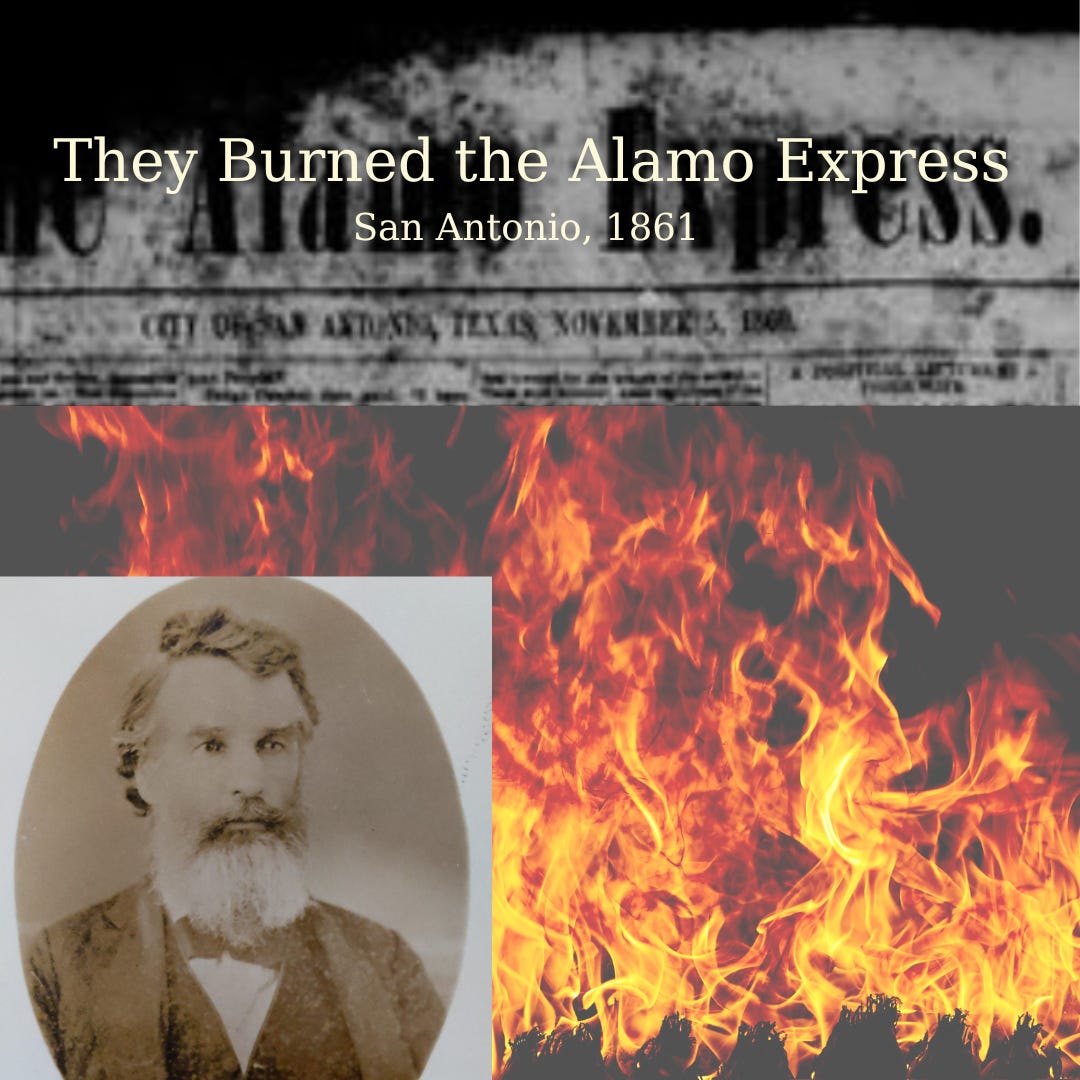
On May 13, 1861, the Knights of the Golden Circle (“KGC”) burned down the Alamo Express newspaper building, while chasing its editor and publisher out of the country on threat of lynching. At the time, my third-great grandfather was the “Adjutant General” of the KGC in Texas, and there’s little doubt he played a role in the terrorism.
Charley Russell and the KGC sought to create a police state governed by patrols of armed white men controlling (and, inevitably, lynching) Black bodies. Today, the uniforms, gear, and weapons look different, but the outcomes are much as Charley imagined them. From slave patrols and the Klan, to George Floyd and ICE raids that tear families apart, white control of Black and brown bodies has persisted – as has white control over those of any race who stand in opposition.
Please subscribe to follow the arc: truth → healing → transformation & repair. And help this book reach a wide audience by sharing with someone who’d value it.
The Paramilitary Group: Knights of the Golden Circle
Charley’s son Lyman (Happy’s great Uncle Lyman, the genealogist) wrote a 12-page biography of his father that has been passed down as part of my family’s legacy photos and documents. He clearly adored his father, and the biography takes pains to excuse certain faults. But whitewashing and apologetics do not erase the facts. Lyman wrote:
In the years immediately preceding the Civil War, a secret military society called the Knights of the Golden Circle became immensely powerful in the United States, particularly in the South. Its chief aims were to annex Mexico to the United States, to continue the institution of slavery, and to oppose the control of the Roman Catholic Church. Though little publicized, this organization found many supporters in Texas, and Charles Russell was among them. He was persuaded by his friends to attend the state convention of the K.G.C. in San Antonio on Feb. 22, 1861, though he was reluctant to do so. But, as he reported in a letter to his wife on March 4, 1861, “it so turned out, and I hardly know [how] I got into it, that I controlled the whole action of the Convention and did almost everything that was done there.” On this occasion, his five years of experience with the U.S. Army enabled him to understand quickly the working of the organization, and he presented his knowledge with such force to the assembled members that he was unanimously elected “Adjutant-General for the State of Texas.”
The organization was secret, but those in its ranks knew exactly what they were getting into. In the 1850s and 1860s, during the initiation ritual of the Knights of the Golden Circle, new members were told, among other things:
[Speaker 1, “Captain”]: a false philanthropy of the Northern people would set … negroes free – and allow them to become Moroons, as in Haiti and Jamaica.1 They would bring this negro on a par with the white citizens socially and politically.
[Speaker 2, “Guide”]: This can never be, since nature has clearly marked their inferiority. The white race or the black must rule, and we prefer that it shall be the white.
[Speaker 3, “Lieutenant”]: Slavery is a conservative institution that guarantees peace and quiet in society and opposes every innovation of the laws and traditions of our fathers. Where climate and soil will justify, it will flourish and exist. 2
Charley’s Role and the Home Police Plan
The Knights of the Golden Circle was a paramilitary organization, and it sought to establish a police state. As the chair of the KGC’s Committee on General Military Affairs, Charley wrote of the group’s “purpose of making the K.G.C. effectual as a home police,” in order to quell any threat of “servile insurrection.”3 Among other things, Charley’s plan for the KGC to become a “home police” almost certainly envisioned the KGC organizing patrols to catch runaway enslaved people. KGC “General Regulation 6” stated “It shall be the duty of the military company in each Castle [local chapter] to aid and assist the civil authorities in bringing to justice all offenders against the laws of the State of Texas in relation to slaves and free persons of color; and it shall be the duty of said Military company to act as a police company under the laws of the State.”4
For Charley’s part, much of this military organizational work took place in the immediate aftermath of the KGC’s Texas convention in February 1861. That KGC Convention in San Antonio ended only days before Texas held the second session of its Secession Convention in Austin. Charley was a substitute delegate to the Secession Convention in that second session, replacing the original Karnes County representative. On February 23, 1861, former Union soldier Charley A. Russell voted in favor of secession, as did Texas. The Texas secessionists drafted a list of “causes which impel the state of Texas to secede from the union,” which provided in part:
[T]he non-slave-holding States… [have] proclaim[ed] the debasing doctrine of the equality of all men, irrespective of race or color--a doctrine at war with nature, in opposition to the experience of mankind, and in violation of the plainest revelations of the Divine Law. They demand the abolition of negro slavery throughout the confederacy, the recognition of political equality between the white and the negro races, and avow their determination to press on their crusade against us, so long as a negro slave remains in these States. 5
They Burned a Newspaper
On March 5, Texas joined the Confederacy and went to war.6 But even after Texas joined the war, Charley and the KGC were still bringing the group’s own martial forces to bear. That included waging terror on white journalists who criticized the Knights’ authoritarian plans.
In November 1860, the Alamo Express newspaper had published extensive excerpts from an Austin speech by national KGC leader George Bickley. Bickley proclaimed that “Our people [of the South] must present an unbroken front – no division should now be tolerated.”7 Bickley also admitted that the KGC had been secretly spying on travelers, and marking their baggage as “suspicious” without their knowledge.
In response to Bickley’s public comments, the Alamo Express decried that “We would hold no political party responsible for this secret order [of the KGC]; but trust that all parties will disavow it as a secret political engine. In its secrecy, in its police espionage and its avowed southern confederacy disunionism, we see nothing but mischief.”8 The newspaper added that the KGC was an “ambitious scheme of a few reckless bad men.”9 After that, the Express continued to call out the KGC on frequent occasions.
Six months later, on May 13, 1861, two local “Castles” of the KGC burned down the Alamo Express newspaper building. It was “later determined that the KGC had intended to hang [James P. Newcomb, the publisher of the Express ], and either hang or banish some 150 prominent citizens of San Antonio suspected of disloyalty to the new order.”10
On May 16, 1861, just three days after the KGC burned down the Alamo Express , Charley Russell posted an “Address to the Knights of the Golden Circle in Texas” in the LaGrange Southern Rights Democrat . There, Charley whipped the KGC membership into a martial frenzy, reminding them of their special duty to the Knights, independently of their duty to the State of Texas:
The time has come to shake off the idle day dreams of peace, and prepare for battle. No vain hope can now hover over us. There is no room for hope. No idle words are now needed, but strong arms and willing hearts. War is upon us; our homes and firesides are threatened with invasion. I need not exhort you to arm and prepare for the conflict…. But while I am satisfied with your patriotism and your bravery, I am fearful that many may forget amid the absorbing events of the day, the obligation which they owe to the Order of Knighthood in which we claim to be brethren .11
Why This Still Echoes
Later, nearly all of the members of the KGC, including Charley, became soldiers for the Confederacy, and thus the war effectively swallowed the KGC in Texas. As a result, Charley’s plan to create a KGC police state never found traction. Nonetheless, Charley’s conception of using paramilitary forces to hunt down Black men is one that has chilling resonance more than 160 years later. As one recent scholar put it:
Police militarisation leads to more confrontational, violent, and deadly policing. The burden of militarisation falls disproportionately on racialised minorities. An ACLU report found that “the use of paramilitary tactics and weapons primarily impacted people of color.” Fatal police shootings of unarmed black people in the United States are three times higher than white Americans.12
Even before the KGC, the history of law enforcement organizations in Texas (and elsewhere) can often be traced back to efforts to catch enslaved people. “Police departments did not exist in the early United States. The first organized policing groups were slave patrols[.]”13 “Slave catching dominated early Texas security apparatus.”14 Charley added his own spin to that legacy by overlaying paramilitary organization over the existing concept of civilian “slave patrols.” Horrifyingly for me, in this respect Charley Russell was centuries ahead of his time.
Connecting all of these historical dots creates a nightmarish image in my head that I fear may haunt me: my great-great-great grandfather, cloaked in modern paramilitary gear, kneeling on the neck of a Black man.
In Between the World and Me , Black journalist Ta-Nehisi Coates wrote a letter to his then 15-year-old son, in the form of a 176-page book. He told his son:
Here is what I would like for you to know: In America, it is traditional to destroy the black body – it is heritage.15
My chest tightened when I first read those words in 2017. But now they land even harder, because I know that destroying the Black body is a documented part of my heritage. And I now have three Black grandchildren. Eventually, I will somehow have to explain to them that this is part of their heritage as well.
Join the conversation : Drop a comment below:
What’s your reaction to Ta-Nehisi Coates’ message to his son: “In America, it is traditional to destroy the black body – it is heritage”?
What steps should white people take to heal that poisonous heritage? What steps are you willing to commit?
I read and respond to every comment.
1 “Moroons,” as used here, is an alternative spelling of “maroons,” who are formerly enslaved people and their descendants who escaped slavery through either flight or being freed (also called “manumission”). https://en.wikipedia.org/wiki/Maroons (accessed July 4, 2025).
2 J.W. Pomfrey, A True Disclosure and Exposition of the Knights of the Golden Circle (1861) (from a copy given to the library of the University of Texas by Mrs. Alice Atkinson Neighbors in 1936) (digitized and sent to me in 2025 by the Dolph Briscoe Center for American History at the University of Texas). Mrs. Alice Atkinson Neighbors was my grandmother Happy’s Aunt Alice, and the granddaughter of Charles Arden Russell.
3 Randolph W. Farmer, The Knights of the Golden Circle in Texas: How a Secret Society Shaped a State at 251 (2021).
4 Id. at 252.
5 DECLARATION OF CAUSES: February 2, 1861. A declaration of the causes which impel the State of Texas to secede from the Federal Union. http://tsl.texas.gov/ref/abouttx/secession/2feb1861.html (accessed Aug. 3, 2025).
6 Walter L. Buenger, “Texas Secession Convention of 1861: An Historical Overview,” in Texas State Historical Association’s Handbook of Texas https://www.tshaonline.org/handbook/entries/secession-convention (accessed July 6, 2025).
7 Alamo Express , Nov. 5, 1860 p.1, column 4. https://scholarworks.uttyler.edu/cgi/viewcontent.cgi?article=1001&context=cw_newstitles (accessed Dec. 15, 2025).
8 Id.
9 Id. at p. 2, column 4.
10 Farmer, supra , at 305.
11 Id. at 306.
12 Professor Jude McCulloch, “Police Militarisation, Racism, and Colonialism,” Australian Institute of International Affairs, Sept. 23, 2022. https://www.internationalaffairs.org.au/australianoutlook/police-militarisation-racism-and-colonialism/ (accessed July 5, 2025).
13 Ruth Weingarten Foundation, “A History of Racism in Policing, the Texas Rangers, and the Texas Border Patrol,” https://www.womenintexashistory.org/making-history-now/history-of-racism-in-policing/ (accessed Aug. 18, 2025).
14 https://gritsforbreakfast.blogspot.com/2020/08/slave-catching-dominant-early-texas-law.html (posted August 29, 2020, and accessed July 5, 2025). “Grits for Breakfast” is a blog about the Texas criminal justice system, which has been relied upon for decades by journalists covering proceedings in Texas criminal courts. Coincidentally, the author and originator of “Grits” was my best friend in high school, Scott Henson. In a series of blog posts in August and September 2020, Scott laid out in great detail many of the historical connections between Texas’ first law enforcement groups and slave catchers. Over the years, Scott and I have stayed in touch, and I’m proud to still call him friend. His research skills have always far outstripped my own. He’s also spent his career being a far better advocate for racial justice than I have ever been.
15 Ta-Nehisi Coates, Between the World and Me (One World Essentials) (Kindle ed. 2015) at 103.

bottom of page