top of page
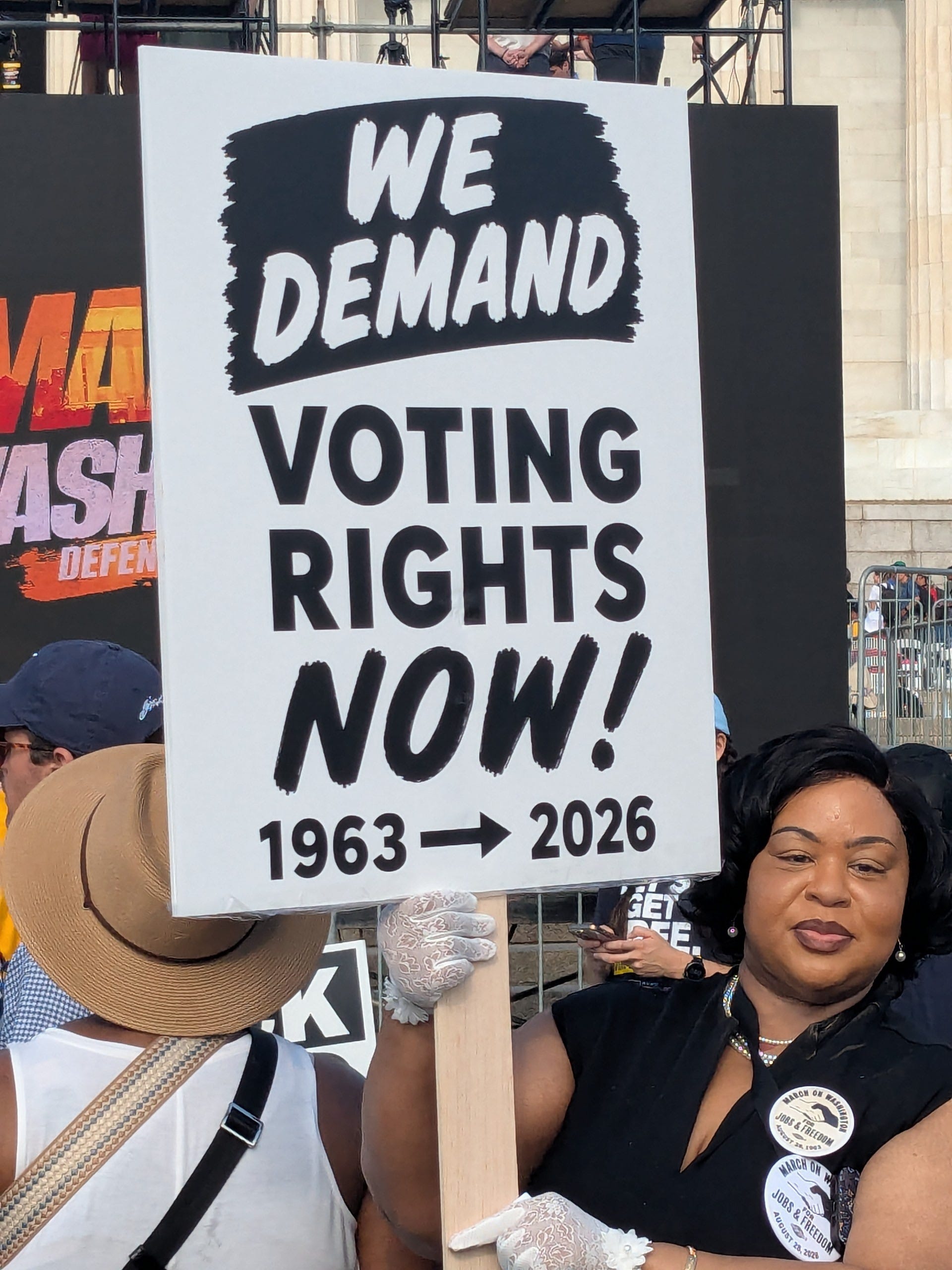
From my trip a week ago for the March on Washington 2026 - Defend the Vote
Last week I (re)learned that sometimes the most effective and important thing I can do to support racial justice is shut up and write the damned check.
I’m passionate about helping People of Color regain meaningful voting rights. 1 The current Supreme Court claims that Black and brown people have made enough progress 2 – the same argument that the racist Court made when striking down the Civil Rights Act of 1875. 3 So now, our current Court has weaponized color blindness to prevent the Voting Rights Act from being used to protect against racial gerrymandering.
Healing White History is a reader-supported publication. To receive new posts and support my work, consider becoming a free or paid subscriber.
A little over a week ago I was in Washington, D.C. with my former law partner, for the March on Washington 2026 - Defend the Vote. In May we had also traveled to Montgomery, Alabama for the “All Roads Lead to the South” rally. 4
The battle cries from voting rights rallies echo in my head: “We’re not going back! We’re not going back!”
So I’ve been thinking about how white folks like me can help. I recently learned that here in Dallas, we have a terrible problem with voter turnout. Fewer than 10% of registered voters typically show up to vote in “standalone” elections for municipal offices like mayor, ranking Dallas 29th among the 30 largest American cities. 5 And midterm election turnouts in Dallas swing wildly – from 34% to 57% over the past 12 years. 6 And all of this made me think that “Get Out the Vote” efforts in Dallas may be even more critical than voter registration.
My Unoriginal Idea - Busing Black and Brown Folks from Churches to the Polls
My idea came to me a few months ago. What if we could raise money from “white allies” in Dallas to rent buses that would carry Black and Latino congregants directly from their churches to the polls? I raised the idea at a meeting of my church’s racial equity task force. One Black person cautioned that those churches may not want this kind of help from a white church. But another Black person pushed back: “Why not?”
To be clear, my idea is hardly original. Black churches have been doing the same thing for decades: they call it “Souls to the Polls.” 7 They know how to do this work.
Still, I decided I would explore the idea further. A few weeks ago, I asked a local Latino activist whether it could work with Latino churches. He expressed soft encouragement, and said that he wanted to think about it more. We also discussed that the federal administration has threatened to send ICE to the polls, and whether some white folks could be trained to help Latino voters exercise their rights.
All of this sounds pretty promising, right?
But then I got a couple of reminders of how this process is supposed to work.
First, despite a few follow-up emails from me, I got no immediate response from the Latino activist.
Second, a white friend who loved my idea ran it past the community justice pastor at his church. She told him that it might be a good idea. But she also said that, in her church’s experience, when the white church approaches Black churches with programming ideas – even when there is already a good relationship between the churches – they are typically politely declined. What works instead is showing up when called, or just providing money to help them do what they’re already doing. My friend reported that conversation with his pastor back to me, and it immediately rang true.
The third reminder came when I wrote a different email to the Latino activist. This time, I just told him that I have identified a few donors who would like to help with whatever get out the vote efforts his group was organizing for the midterms. He wrote me back the next day.
Relationships Before Partnership
Here’s the problem: I don’t have any kind of relationship with any Black or Latino churches in Dallas. And I have few real relationships in the racial justice activist community. My racial justice work over the last eight years has been focused on educating white folks about racial equity, and asking them to be introspective about the different ways in which they have (mostly unknowingly) participated in upholding racially inequitable systems. I’m trying to change that focus now, but I’m only just beginning.
A few months ago I watched a webinar with Black and white clergy from Evanston, Illinois, who had worked together on the city’s racial reparations efforts. 8 It took years. It was hard. As you can imagine, there were many obstacles. Ultimately, together with city officials and others, these Black and white clergy helped build the first municipal reparations program in the country. In 2021, the city created a program that provides $25,000 each to Black folks and their descendants who had been harmed by redlining, racist zoning, restrictive racial covenants, and other racist city policies, from 1919 to 1969. 9
I took away one central message from that panel discussion, which all of the participants emphasized repeatedly: if white people want to help create change, there is no shortcut to building relationships across racial lines. White folks have a long history of being the “weak link” when it comes to racial justice. 10 Over and over again, as Black and brown people have fought to achieve gains after the Civil War, white Americans have risen up in backlash. And over and over again, the so-called white “allies” have failed to stay the course and stand together with People of Color to create a just society. When the serious pushback starts, most of us have just quit doing the work.
Is it any wonder that Black and brown folks don’t trust white people who look not only to jump on the racial justice train, but also push their way to the driver’s seat?
I’ve not yet built meaningful relationships with people who do racial justice work. I have not earned any trust in that community. I can’t just step in at the last minute to “fix” the problem. That’s white saviorism.
From “Allies” To Underwriters
We white folks might be better off thinking ourselves more often as “underwriters,” as opposed to allies. In a recent essay celebrating Dolly Parton, Melissa Bradley planted the idea for me. Bradley is a Black leader in the financial community. She has founded multiple venture capital funds, including the 1863 Fund, which are designed to create a “more inclusive, just, and sustainable version of capitalism.” 11 She is also a professor at Georgetown University’s McDonough School of Business. She wrote this about Dolly as an “underwriter” of racial justice:
She sent books and cash. The unit of measurement was not statements issued. It was books delivered and dollars landed. If your justice work has no line item, it is not work. 12
Bradley also notes that “ally” is a noun, which means “you can be one while sitting perfectly still.” “ It is an identity claim, and identity claims are cheap.” 13 She points out that, in addition to thinking of themselves as “underwriters,” white people looking to help make a more equitable world might consider themselves “accomplices” or “co-conspirators.” I like both of those descriptions, because they teach that this work requires disruption and dismantling of existing power structures. And they require action.
I don’t think we white people should be limiting ourselves to writing checks for racial justice. But we do need to understand that, unless and until we build the relationships necessary to create true partnerships and alliances with People of Color, writing a check is probably the most effective thing we can do in the short term.
To be clear, this needs to be a shift of resources to help Black and brown folks do what they’ve already been doing for decades – no strings attached.
Do It. Then Do It Again.
Maybe the most important thing I’ve learned from my recent “get out the vote” efforts is that we need to stick with this. We will find a way to make a difference, if we just push past the discomfort we may feel when not every plan or idea is a success.
I often write that racial justice is white people’s work. And it is. But it’s also true that white people need to ask People of Color what they need and how they can help. I’m still learning how to be a racial justice activist, and I still make a lot of mistakes.
And here’s where my own cultural conditioning pushes against me doing this work: I hate making mistakes. They’re embarrassing. They make me feel dumb and ignorant. Despite all the therapy and work I’ve done to make myself less of a perfectionist, it’s still my emotional default. And if I let it, my lingering perfectionism would gladly take me by the hand and lead me, smiling, back to my comfortable couch in my comfortable house, where I can rest. Comfortably.
And that is but one of the many ways that white supremacy culture puts up roadblocks to stop racial progress.
But the reality is that the roadblocks we face as white people pale when compared with the backlash that People of Color face whenever they seek justice.
As I wrote in March:
In 1964, Fannie Lou Hamer lost. She filed the testimony, challenged the election, and lost. Then she did it again. That persistence is the lesson Black history has been trying to teach white America for generations. 14
We need to celebrate real civil rights heroes like Fannie Lou Hamer. But we also need to create a culture and lifestyle around white people doing racial justice work. We need to build relationships across racial lines. We need to find joy to sustain the work, and remember to come back to those sources of joy regularly.
Do it. Then do it again.
Please subscribe to follow the arc: truth → healing→ transformation & repair.
1 See, e.g. ,
2 Louisiana v. Callais , 608 U.S. __ , 146 S. Ct. 1131, 1148–49 (2026) quoting Shelby County v. Holder , 570 U. S. 529 at 549, 553 (2013)) (citing the “great strides” created by the Voting Rights Act in previous decades: “voting tests were abolished, disparities in voter registration and turnout due to race were erased, and African-Americans attained political office in record numbers.”)
3 Civil Rights Cases , 109 U.S. 3, 25 (1883).
4
5 Jessica Huseman, “May-November advance: Why moving the timing of an election matters,” Votebeat (Nov. 17, 2025)
https://www.votebeat.org/2025/12/15/dallas-city-council-moves-elections-to-november/ (accessed Sept. 7, 2026).
6 Data is from the Texas Secretary of State website: https://www.sos.state.tx.us/elections/historical/dallas.shtml (accessed Sept. 7, 2026).
7 David D. Daniels III, “The Black Church has been getting ‘souls to the polls’ for more than 60 years,” The Conversation (October 30, 2020) https://theconversation.com/the-black-church-has-been-getting-souls-to-the-polls-for-more-than-60-years-145996 (accessed Sept. 7, 2026).
8 https://www.uua.org/multiculturalism/reparations-community (accessed Sept. 7, 2026).
9 For a longer discussion of Evanston’s reparations program, and the Trump Administration’s efforts to unravel it, see https://healingwhitehistory.substack.com/p/the-inheritance-of-grievance-i-dont?r=e2z7c .
10
11 https://www.eda.gov/strategic-initiatives/national-advisory-council-on-innovation-and-entrepreneurship/board/2022-24/melissa-bradley (accessed Sept. 7, 2026).
12
Melissa Bradley
Dolly Parton Was Not an Ally. She Was an Underwriter.
Dolly Parton died at eighty. The tributes will be enormous, and most of them will be wrong about why she mattered…
Read more
13 days ago · 1060 likes · 59 comments · Melissa Bradley
13 Id.
14

bottom of page